May-October – Our solar battery data

So, here’s our 6 month update of life with Bert our Wattstor battery (May to October). Every month we learn new things.

As well as the shorter days, October has been rather misty and murky but still our 4 kW PV panels are often generating enough during the middle of the day to cover our energy demand in real time and, after dark, Bert-the-battery is still often able to service our evening cooking (which is mostly done on electric).

The first chart shows daily Wh averages – our daily demand, the amount generated by the solar PV, the amount we’ve had to import from the grid and the amount we’ve exported to the grid because it’s more than the battery can absorb at any point.

mayoct2

Not surprisingly, our daily demand has now crept up to an average of 8.5 kWh/day. This increase (we think) is a combination of  lighting and the pump for the boiler. We’ve also had two lots of visitors in October which always makes a difference!

The solar is now dropping significantly (5.2 kWh/day) because of shorter daylight hours, the sun lower in the sky and it disappearing behind the trees and October being rather dull.

We’ve imported almost twice the amount from the grid than we did in September (5.o kWh/day). One big difference is that our Twizy (which also has a 6kWh battery) and charges at 2kW can no longer charge reliably directly from solar during the day so we have switched to charging the Twizy from the grid after dark to avoid pointlessly taking energy from one battery to fill another. Looking at these data certainly brings home to you what it would be like if we owned a full sized electric vehicle. They are energy hungry beasts and no domestic solar system is going to be able to cater for them all year around. Fortunately, the Twizy (which manages all our local journeys) operates at 140 Wh/mile which is why we chose it.

And, finally, the system has rarely been in enough solar credit during the day to export to the grid rather than filling the battery. So, the amount we have exported has dropped to 1.2 kWh/day which means we are not currently contributing much to our fellow citizens! (Neither incidentally are the many domestic hydros around our area as the mountain streams have dried to a trickle given the lack of rain for a month or more).

Another big change is one that has been programmed by the Victron system. The lead acid batteries only ever operate between 50% and 100% capacity. In the summer, the batteries would often fill to 95-100% during the sunshine hours and then empty each night down to ~50% before switching off. Once the solar stopped providing that many Wh to the battery, the battery started switching off at around 70% – 75% . It appears to be estimating the amount it’s likely to manage top up by the following day and aiming to cycle around in the top end of its limit (rather than the bottom) to best preserve the battery.

The 2nd chart shows the proportion of our daily electricity provided by each source and how that is changing each month:-

mayoct

As already mentioned, the amount we are now taking from the grid has almost doubled from September but we are still getting 40% of our demand via solar and this would be down to  21% without a battery. It’s interesting that the split between solar (direct) and solar time-shifted via the battery remains roughly equal. Will that still be true in mid-winter?

Posted in Technology | Tagged , , , , | Leave a comment

1000 footsteps, foraging & mere exposure

img_20161022_195016Last Saturday night, I attended the inaugural 1000 Footsteps pop up restaurant event. Adele Nozedar is a foraging guru and her partner, Liam Fitzpatrick a chef. Together they are creating unique meals where the vast majority of the ingredients have either been gathered from the hedgerows or grown within 1000 footsteps of their home in the Brecon Beacons National Park.

30 of us sat by candlelight in the warmth of a blazing log fire in Llangasty village hall as Adele and her team produced dish after dish after dish throughout the evening. Each dish exotically named with little or no resemblance to food we’d seen, heard of or tasted before – “drunken chicken in the woods”, “poor man’s cheese” etc etc.

Much laughter and interesting conversations reverberated round the table triggered by the many novel looking, sounding and tasting ingredients. But after a couple of courses, I found myself increasingly craving something familiar – “please please give me a taste I can recognise – one to which I can attach a known adjective!”. It’s not that I disliked any of the completely new tastes but I found I wasn’t particularly relishing them either in the sense of “wow, give me more of that!”

So, then the psychologist kicked into action – what was happening here? Did I not like foraged foods? Why was my brain almost shouting to be given something it recognised – something to latch onto.  At that point, I realised I was experiencing the “mere exposure effect” in action.

img_20161022_201815Mere-exposure is a psychological phenomenon by which people tend to prefer stimuli to which they have been previously exposed and the more they are exposed to them, the stronger their liking grows. Experimentally, the mere exposure effect has proved robust across all kinds of stimuli – visual images, music, words and tastes. And, intriguingly, stimuli which you are not conscious you have encountered before (because they were presented subliminally for example) show an even greater effect on liking than ones you are aware you’ve encountered before. One explanation for mere exposure is that we favour things which take our brains the least effort to process.

So, whilst hesitant to offer advice to an experienced forager and talented chef, I have two thoughts on their 1000 Footsteps venture from a psychology perspective…

I suggest subtly re-introducing some of the more novel ingredients from Course 1 into Course 3 or 4 and see if people like them better 2nd time around whilst not necessarily realising they have actually tasted them already! Also combining the unknown (taste wise) with more of the known and familiar might help the more novel-nervous. Research shows that we improve our chances of developing a liking toward a new experience if that experience has at least some familiar elements in it.

And for those of you out there who haven’t yet signed up for a 1000 Footsteps pop up dinner, my advice is ‘go for it!’ It’s a fabulous experience and by expanding the tastes which you’ve now experienced (if only once!), you stand to significantly increase the enjoyment you derive from eating …..or for that matter anything!

Posted in Psychology | Tagged , , , | Leave a comment

Living with Bert-the-Battery for 5 months

We’ve now had our Wattstor 6 kW battery (‘Bert’) for 5 months. The first chart shows our daily kWh averages and how they are changing as summer tails off into autumn.  Our daily average demand (red) has remained relatively consistent at 7.5-8 kWh a day other than June when we had 2 weeks away.

maysepavs

The PV generation (yellow) is dropping sharply with the shorter days and lower sun in the sky which (in our case) disappears behind two trees in the adjacent field in the afternoon. The average surplus kWh we have exported to the grid each day (green) is falling and the average we have had to import from the grid (black) is now rising sharply. September was the first month we have taken more from the grid than we exported to it.

For many happy days in high summer, the PV panels and Bert met all our demand and we imported nothing from the grid at all. But in September, the daily import needed from the grid rose sharply once we were cooking supper after dark and Bert could no longer reach 100% capacity from the day’s sun.

The second chart shows the proportion of our daily electricity demand which came from each source and how that is changing month to month.

maysept1

The grid provided only 4% of our electricity in June and July but in September was up to 33%. The proportion of energy we take from the solar panels directly versus from the solar via the battery is also changing. In the last two months we have taken a higher proportion from the battery than directly from the sun. Again, we think this is because our consumption peaks in early evening (like most of the population!) when we are cooking (mainly on electric) after the sun has set.

Thierry Twizy above Usk Reservoir

Thierry Twizy above Usk Reservoir

On the days we need to charge our Renault Twizy, the solar PV (4kW) is rarely able to consistently provide all of the power required (2kW) for a few hours so the rest is taken either from Bert-the-battery (if he’s full enough) or the grid.

Fortunately, our Twizy only has a small battery 6kWh (same capacity as Bert) and operates at very low energy (140 Wh/mile). In this country, you’d need a huge South facing property with maybe 8-12 kW of PV panels to be able to charge a full-sized electric vehicle every day and still have surplus Wh to fill a domestic battery. And, as discussed previously, we now think it would be horribly complex to double one’s electric vehicle battery as domestic storage. The two usage patterns are too often in direct conflict.

Posted in Psychology, Technology | Tagged , , , , , | Leave a comment

Is playing golf on a Friday afternoon such a bad thing?

Liam Fox recently told an audience of Tory activists that it’s the “duty” of our business leaders “to contribute to the prosperity of our country”. Instead, Fox complained, they are letting us down by choosing to play golf on Friday afternoons rather than spending the time finding new export markets and growing their businesses.

The UK business community were understandably up in arms about Fox’s comments – particularly his description of them as having become “fat and lazy” on past successes. Businesses and other politicians were quick to point out how hard all businesses work with no time at all for playing golf.

But, what if we look at both Fox’s comments and the reaction of businesses and the media to his outburst through different eyes?

Why is playing golf on a Friday afternoon rather than working to grow the market for your business such a bad thing? Is it because it’s golf – arguably an elitist, rich man’s sport? What if these business leaders take Friday afternoons off to walk in the country with their partner, or visit an elderly relative or sing in a choir or play football with their kids? Would we deem that a better or worse way to spend an afternoon than signing up new trade deals? And what if the business leader in question also gives all his or her employees Fridays off to spend doing something of their own choice other than work? Does that contribute more or less to the ‘prosperity’ of our society? What if some don’t even want or need their business to grow – is that bad or ‘undutiful’? Maybe they are quite happy at its current size and turnover and would rather they and their employees had time for other interests in life and time to spend with friends and family?

It depends how we understand national or individual prosperity and whether it is actually  dependent on our GDP in the way that successive governments clearly believe. As Professor Tim Jackson points out in his book ‘Prosperity without Growth‘ “The narrow pursuit of growth represents a horrible distortion of the common good and of underlying human values“.  Robert F Kennedy recognised this right back in 1968 “the Gross National Product measures everything in short, except that which makes life worthwhile“.

So what if we consider an alternative definition of prosperity as “a successful, flourishing, or thriving condition“? That certainly challenges whether spending Friday afternoons working hard to negotiate new trade deals and thus expand shareholder dividends represents the best way to contribute to one’s own or the nation’s prosperity. It’s also a definition of prosperity which might stimulate a wider debate around the possibility of a universal unconditional income as a way to cope with the reduction in paid jobs and reduce the ever-widening gap in equality. In contrast, Liam Fox’s call of duty to grow business and shareholder profit will certainly do little for economic equality.

Having never played golf and with no desire to do so my advice is nevertheless: “enjoy your Friday golf …. but think about giving all your employees the afternoon off too….”.

Posted in Psychology, Uncategorized | Tagged , , , , , | Leave a comment

Simply touching money makes us less helpful

I’m working on a project with the artist group, Larks and Ravens, on the topic of money – what is it?, where did it come from? what’s it doing? And how on earth did we get to a point where inequality has grown to a point where 62 billionaires own as much as the poorest half of the world’s population?

Two independent pieces of information caught my attention today  – both relate to the effect money has on how we behave. The first was a quote from a speech which Boris Johnson made to the City back in 2013 when he was still Mayor in which he said “I stress – I don’t believe that economic equality is possible; indeed some measure of inequality is essential for the spirit of envy and keeping up with the Joneses that is, like greed, a valuable spur to economic activity.”

The second  is a series of psychological studies demonstrating how thinking about or handling money increases people’s people’s motivation and problem solving persistence in ways that make them more successful but it also makes them less aware of and helpful towards others.

The results of nine experiments suggest that money brings about a self-sufficient orientation in which people prefer to be free of dependency and dependents. Relative to participants primed with neutral concepts, participants primed with money concepts preferred to play alone, work alone, and put more physical distance between themselves and a new acquaintance. In one experiment, a pedestrian close to a cash machine dropped a bus pass. Passersby who had just taken cash from the machine were less likely to stop and help the person than people who had not used the cash machine.

More startling is the discovery that the effect of handling money holds for children as young as 3 years old.  In one experiment, young children were instructed to sort money by denomination, while others sorted buttons by color. They were then given a maze to solve and were told they could quit at any time. Money sorters worked longer and were more successful at solving the maze than button sorters. In another experiment, 3 year-olds sorted either coins and banknotes, or buttons and paper slips before being asked for their help tidying up materials ready for the next child to take part.  Money sorters were less helpful than button and paper sorters.

So, Boris, you might indeed be right that money (or the desire for money)  motivates activity which leads to further financial reward but, if it simultaneously makes the people dealing with money ever more self-sufficient and less aware of or willing to help others, then maybe no wonder we end up with the level of inequality we have in the world today.

Posted in Psychology | Tagged , , , , | Leave a comment

Electric vehicles as storage – a psychologist’s view

“LONDON (UK) 10th May 2016: Automotive industry leader Nissan and multinational power company Enel, today confirmed plans to launch a major vehicle-to-grid (V2G) trial – the first ever carried out in the UK. The trial will work by installing and connecting one hundred V2G units at locations agreed by private and fleet owners of the Nissan LEAF and e-NV200 electric van. By giving Nissan electric vehicle owners the ability to plug their vehicles into the V2G system, owners will have the flexibility and power to sell stored energy from their vehicle battery back to the National Grid.”

V2G is a novel concept which clearly excites both journalists and academics (always a tricky combination if neither have experience of using the technology in question in their everyday lives).  In contrast, Nissan’s parallel set of trials (redeploying old EV batteries as home storage units) offers a  more practical and environmentally useful initiative but it doesn’t excite the journalists and is even sometimes mis-reported as being vehicle-to-grid (V2G) because the latter is viewed as sexier.

But, as a behavioural psychologist and EV owner, I have always been doubtful as to how V2G would work practically in the home.

signpost -comp

Thierry Twizy

We have owned a small electric vehicle (a Renault Twizy) for 4 years and use it every day for all our local journeys,  rarely using our other car. We try to arrange to charge our Twizy when the sun is shining so it can get as much of the power it can from our 4kW solar panels rather than from the grid. Even so, because the Twizy battery (6kWh) consumes 2 kW for much of its charging cycle, it is rare for it to manage to recharge purely from the output of our 4kW solar panels given the background loads in the house at the same time.

Bert Display

PV exporting to battery & grid – 4pm in May

Our situation has now changed. A month ago, we had a Wattstor 6 kWh energy storage system installed by Gwent Energy CIC because we were keen to use as much of the solar PV we generate for our own domestic consumption rather than exporting it to the grid. We work from home and, in May through to October, most of the energy our home requires during the day (when the light levels are high) is covered by the solar output with plenty to spare which we then export. But as soon as the sun sets, we are back to importing from the grid regardless of how much solar the day has generated. That is no longer the case. With our new system, our excess solar is now stored by the Wattstor battery enabling the house to use that solar energy during the evening and night rather than importing from the grid.

In May (close to optimum daylight length), the Wattstor system has reduced our grid import to less than 1 kWh a day. However, we are now experiencing a direct conflict between charging the Wattstor battery and the Twizy battery (both of which require 6kWh to fill). They are proving serious competitors for the same energy and this generates extensive discussion (even the occasional dispute) between the household members as we discuss timings and priorities for the disparate power requirements and timings.

If we charge the Twizy during the day,  then we are unlikely to manage to fill the Wattstor battery ready for the evening (unless the sun is blazing for the entire day). If we wait until evening (as sometimes our travel pattern requires), then the Twizy will completely empty the Wattstor battery leaving none for the house. After 4 weeks, we are still discussing which battery is best to fill when and we are lucky in that much of our travel needs are flexible enough to give us some choice. For others who use their EV to commute to work, this would not be the case. It’s also unlikely that any household with a Nissan Leaf could ever generate enough from a domestic Solar PV installation (unless it was twice the average domestic size) to meet its 7kW charge rate.  This suggests that the V2G schemes are not motivated by renewable goals.

Like most EV drivers (even those with much greater range than the Twizy), we prefer to keep our EV battery close to full so we are ready for any journey however unpredictable in length or timing (which local journeys tend to be).  Using an EV battery to power the house at any point or to export electricity to the grid at peak periods would be difficult to optimise via any algorithm (domestic lives and energy uses are too unpredictable). Operating it manually would require daily planning and negotiation among household members about anticipated trips or heavy household consumption (e.g. cooking in the electric oven or operating a tumble dryer).

In my mind therefore, supplying  a household’s disparate energy needs (or making a small return from selling energy to the grid) does not combine easily with supplying a household’s transport energy needs. The two (as we are discovering in our own small domestic experiment) are definitely at odds with one another and working out how to satisfy both (other then maybe than in a fiercely regulated and predictable household) is  too complicated for people to bother. It might sound technically attractive but it’s not a natural behavioural fit. We are used to having a shared energy source (be it grid or domestic battery) which can meet any of the variety of needs which crop up. We don’t need to choose whether or not to operate the washing machine now in case we need spare energy for cooking supper later.

(This leaves aside the separate issue of EV owners who fill up their EV’s from public charge points as they travel who might subsequently sell that electricity back to the grid or use it to power their homes. That’s a separate can of worms and one for an economist rather than a psychologist).

So, I shall watch the upcoming V2G trials with interest and see if asymmetric sharing of domestic and travel energy sources works better than I am predicting.


Posted in Psychology, Technology, Uncategorized | Tagged , , , , , , | Leave a comment

What does it mean “to know by heart”?

There’s an intriguing recent study showing that people’s sense of whether faces are familiar to them or not is affected by physiological signals from the heart. The experimental subjects were wired up to a heart monitor and during the facial memory test, some of the faces were presented at the precise moment that the heart had just pumped a burst of blood into the arteries (systole phase), while the other faces were presented while the heart was relaxing (diastole phase). Subjects were more likely to say that they had seen the faces before (whether they had or not) if the faces were presented during the systole rather than the diastole phase. Read more about the study here.

Yet another thought provoking example of how bodies inform minds.

Posted in Psychology, Uncategorized | Tagged , , , , | Leave a comment

Maybe we’re the ‘weird lunatics’ not them

Challenging article by Slavoj Zizek in the New Statesman about why we, as Europeans, feel so threatened by the migrant refugee crisis. We feel threatened by the strangeness of the other instead of seeing the strangeness in ourselves through other eyes. As he says: … “We should learn to experience ourselves as eccentric, to see our customs in all their weirdness and arbitrariness.”

Posted in Uncategorized | Tagged , | Leave a comment

Talk to the humans….

If you are an academic and/or a scientist, read this recent lecture by Daniel Gilbert. It’s worth it.

Ouch.

Click to access SPSP2016.pdf

Posted in Uncategorized | Leave a comment

Domestic Energy Storage

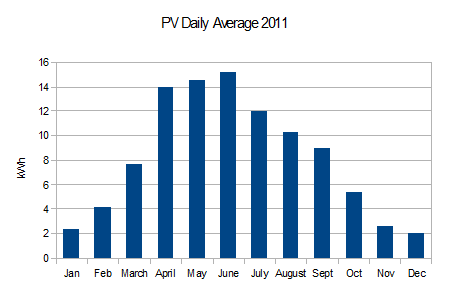
We are thinking of buying a domestic storage battery to better exploit our PV panels.  They already generate more electricity than we use over the course of a year (see graph below), but that doesn’t mean we have sustainable electricity supply.  As everyone – except for its more rabid proponents – realises, renewable electricity cannot satisfy peak demand reliably, and, because we therefore need other more constant sources of power, it is often wasted during demand troughs.

Corlan PV 2011A battery would at least ensure that for a lot of the summer our PV could provide all our electricity and reduce peak demand on the grid.  For much of the winter, of course, it won’t, though if our domestic battery also re-charges itself overnight in the winter, when demand is low, that can at least reduce peak demand.  This makes better use of renewable capacity elsewhere, so is worth doing if we can afford it.

At present, the financial incentive to install a home battery is marginal for most people, although that will change as batteries become cheaper.  If we just used our battery to shift our entire grid demand to night time Economy 7 electricity, our bill would come down from £334 to £222 a year, simply because we would be paying for all our electricity at night time rates.  Being able to transfer any summer daytime surplus PV for evening use will reduce our bill, and our peak grid demand, even further.

Despite the fact that we generate more electricity over the course of a year than we use, we can’t achieve grid independence with a battery only able to hold a day or two’s demand.  A battery big enough to carry our summer surplus over to the winter would probably require planning permission, which is difficult for residents of a National Park.  Plus it would offer fairly poor return on the huge capital outlay.

But I am persuaded that transition to totally renewable electricity generation is going to require fairly substantial storage to make full use of intermittent generation.  Some of this will probably need to be done at the supply end – for example by schemes like the Dinorwig pumped storage scheme, or adding storage to solar and wind farms.  Those might require some incentive to attract the necessary investment.  But storage can play a useful role at the demand end – batteries in domestic and commercial premises can effectively smooth the spiky grid demand curve and smart metering and dynamic tariffs can encourage charging strategies that take maximum advantage of renewable energy gluts.  Here are some further thoughts on the topic.

Posted in Technology | Tagged , , | Leave a comment