Evaluating electric quad bikes for hill farmers

Me on QuadThe Prospectors recently visited Shropshire Quads to try out an electric quad bike. We took a hill farmer friend with us for his specialist experience (of quads, hills and sheep!).

Whilst impressed with the quad’s performance and likely towing and hill climbing ability, we found the gear arrangement  ergonomically awkward (inherited from the petrol version of the same model) and the farmer was unsure whether, at peak lambing season in the Welsh hills, the range of 20 miles would be enough.

We are now planning to log some actual hill farmer quad use to get a more realistic insight into daily mileage and usage patterns and that should help us see if a farmer quad bike trial makes any sense.

You can read our first evaluation of the Eco Charger Eliminator Quad here.

Posted in Technology | Tagged , , | Leave a comment

Low Energy Rural Travel that’s FUN

The Prospectors, Peter and Alison are co-founding Directors of the Eco Travel Network here in the Brecon Beacons. It evolved from our earlier research on rural travel and our 2011 trial of electric buggies.

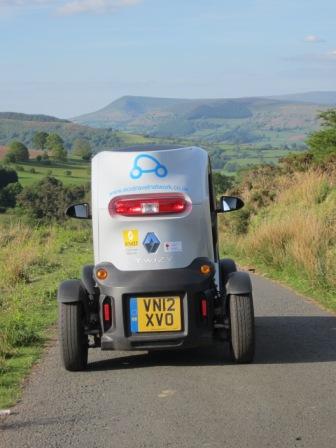
This video about the Eco Travel Network seeks to convey the versatility of the Twizy as a low energy vehicle which is fun and useful for visitors, local residents and local businesses.

Posted in Technology | Tagged , , | Leave a comment

Bodies informing minds & ‘Heads up’ rugby

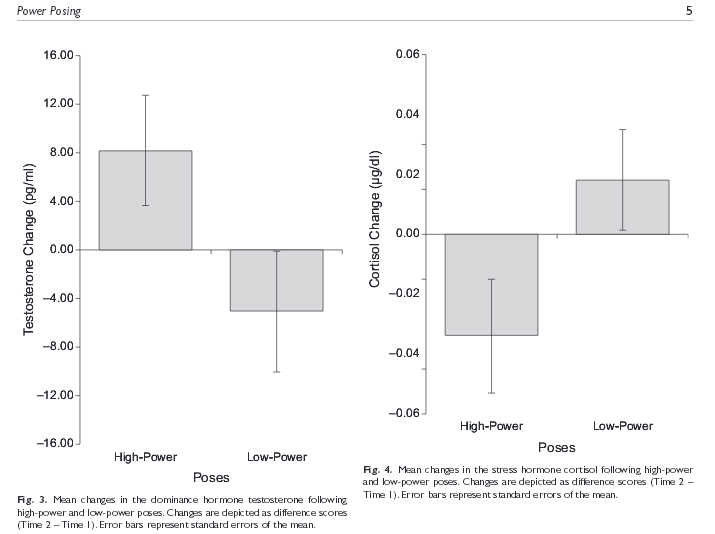
Experiments show that adopting either a high or low power body posture for just 2 minutes changes: how people feel about themselves, their willingness to take risks and their testosterone and cortisol levels (relative to samples taken a few minutes beforehand).

Carney ,Cuddy & Yap Results (2010)

Carney ,Cuddy & Yap Results (2010)

Those adopting a high power pose show a 20% rise in testosterone and a 25% drop in cortisol (stress hormone). Those adopting a low power pose show a 10% drop in testosterone and a 15% increase in cortisol.

On a practical level, this has been shown to effect how they perform in follow-up tasks requiring poise and confidence, e.g. a job interview.

It is yet another example of how our bodies inform our thinking, feelings and subsequent behaviour.

I wonder whether such findings could be used to address the problem of sports players whose “heads drop” (commentator speak) when their opponents score a goal or a try or hit a boundary in cricket. This physical reaction makes it more likely that the scoring side will score again in short order and, indeed, this often appears to happen.

Scoring players typically raise their arms, look skywards, pump their fists and bang their chests.  We recognise this as expressing how the score makes them feel. But we don’t necessarily recognise that the very adoption of such a posture (whether they had scored or not) automatically raises their testosterone level, lowers their cortisol which increases their confidence, their willingness to take risks and their aggression levels. This combination makes it much more likely they will score again in the next few minutes.

Conversely, the ‘scored-against’ players drop their heads, put their heads in their hands and even drop to their knees. Again we recognise that these defeatist postures reflect the pain and disappointment they feel at that moment but, unfortunately, the very adoption of those ‘low power’ postures has a direct effect on their testosterone and cortisol levels affecting a decrease in confidence and aggression and making them anxious about taking any risks. This puts them at a significant disadvantage for the next few minutes of play.

So, what could be different? It would be challenging to implement but maybe players could be instructed, when they have just been scored against to force themselves to mimic (i.e. fake) the bodily postures of their opponents, i.e. lift up their heads, throw their hands in the air and pump their fists. At the very least, this should confuse the opposition (and the crowd!), but if the theory works, then the players won’t experience the same “heads down” drop in testosterone or rise in cortisol and they may hopefully even experience their body chemistry going the right way simply as a response to their “artificial” bodily postures. In theory, that would create a “more level playing field” (as the commentators would say) for the critical next phase of play.

It would at least be fun to try the experiment and certainly it would shock the commentators out of their usual set of clichés as they attempted to explain what they saw on the pitch!

Posted in Uncategorized | Tagged , , , , | Leave a comment

Decarbonising Transport with Electric Vehicles

National and Local Government are backing a shift to electric vehicles, as is clear from their policies:

1.    Electric car grants of up to £5000 off the purchase price.
2.    Exemption from vehicle excise duty.
3.    Exemption from the London congestion charge.
4.    Free 32 amp charge points for electric car in the home.
5.    Free public charge points installed across the country.

Despite this, take-up of electric vehicles has been slow in the UK compared with some other countries. This is because even with the grant, electric cars are more expensive to buy than equivalent petrol and diesel cars, their running costs, if you factor in battery depreciation, are more significant than is sometimes portrayed, and because they can’t (yet) do everything a conventional car can do.

So why is the government so keen that we buy electric cars?

One reason is that road transport is more dependent on fossil fuel than any other sector of the economy. Whether or not you believe that burning fossil fuel changes the composition of the atmosphere in undesirable ways, fossil fuel is a finite resource and will become more expensive to extract.  Basing future energy supply on fossil fuel poses long term risks to the continued growth of the global economy and renders countries like the UK vulnerable to political instabilities in the rest of the world.  If in addition to that you are worried about carbon dioxide levels in the atmosphere, you will want to encourage your citizens to move around without creating more of it.

Fossil fuels could perhaps be replaced by so-called bio-fuels – chemicals derived from plant and biotic source – that are similar enough to petrol and diesel that they can be used by the current internal combustion engine technology and its established infrastructure.  The carbon in bio-fuels is extracted directly from the atmosphere, and can in principle be returned to it on a perpetual basis without increasing its concentration.  Unfortunately, there isn’t enough land to grow all the bio-fuel we need conventionally and continue to feed ourselves, so a wholesale switch to bio-fuels depends on breakthroughs in growth and production technology that do not yet seem forthcoming.  So the best current bet for government is to:

a)    Encourage a switch to electrically powered transport and
b)    .. decarbonise our power generation.

.. and these are indeed the major strands of government policy with respect to both future transport and future electricity generation.  Decarbonising means reducing and in the long run eliminating the need to burn fossil fuel to produce electricity, by increasing investment in “renewable” energy – solar power in the form of rainfall and wind – and in nuclear power.  A switch to electric transport should then put us in a good position to eliminate future dependency on finite sources of fuel.

But in liberal democracy of the kind we cherish in the West, consumers cannot be forced to exchange their existing cars for electric cars unless and until electric cars offer a more complete replacement than they can today.  And this poses challenges.

One of these is refuelling.  Electric cars can be refuelled at home, overnight, every night.  If you have mains electricity, you never have to drive to a petrol station.  From a normal domestic socket (2 – 3kW in the UK) you can put about 25kWh into an electric car battery overnight, enough for around 90 miles of electric motoring.  With a higher powered 32 amp (7kW) domestic circuit you could put in 50kWh, and up to 200 miles, but hardly any electric cars have batteries that large.  This is because of expense and weight. Most electric cars today (2013) have battery capacities between 20kWh and 30kWh and ranges of 90 to 120 miles, which just happens to be the amount of electricity available overnight from a regular domestic power socket.

Government and industry agree that growing electric car sales depends on a network of very fast (45kW and more) charge stations that can re-charge a 25kWh battery in half an hour. Cars with higher capacity batteries will need even more powerful chargers of 100kW and beyond, and these are also in the pipeline.

It is reasoned that, while it takes far less than half an hour to re-fill a petrol tank, electric car drivers will accept having to stop for thirty minutes every 2 hours or so, if that means that they can travel comparable distances at comparable speeds to normal cars (if at slower average speed).  If this reasoning is correct, and technology brings other costs down, there is a good chance that electric cars could, in the next 5 years, offer a realistic replacement for current cars, for many drivers.  And this should result in a significant reduction in fossil fuel consumption as measured by its carbon dioxide emissions.

But critics of electric cars, and there are many who resent subsidising a product that is already affordable only to the relatively well-off, point out that electric cars don’t reduce carbon emissions because power stations emit fossil CO2.  Supporters of electric cars will claim that they themselves have PV panels, or that their cars charge mainly at home and at night when the CO2 density of the grid is lower.  But government public charge point policy, on which future electric cars depend, assumes that more re-charging will be done at high speed, and therefore high power, from the grid and during the day.

But you can’t say that electric cars generate as much fossil CO2 just because power stations burn fossil fuels.  What we need to know is how much carbon dioxide they produce per kilometre driven, and how that compares with normal cars. That way, we can decide whether, and by how much, electric cars can actually reduce our carbon emissions today.  So that’s what I’m going to do.

Well actually, I’m not – the work has already been done by the U.S. EPA (Environmental Protection Agency) with a methodology designed to produce realistic figures for U.S. consumers to use when comparing electric and gas-powered cars.  I’m just going to translate their consumption figures into equivalent UK carbon emissions.  For reasons that you have every reason to suspect, manufacturers do not make any public claims about the carbon emissions of their electric cars.

Instead, they maintain (and some innocents believe) that electric cars are “zero emission” because they don’t emit any pollutants while on the road.  This is true if you are talking about air quality.  Regardless of their view on carbon emissions and global warming, the Chinese government has every reason to switch to electric vehicles if only to make China’s inner cities more habitable.  They just need to remember to site those new coal-fired power stations everyone claims they build every week away from those cities.  The fact is that electric cars cause carbon emissions when they are charged with electricity generated by burning fossil fuel.  The question is how much, and how does that compare with a petrol or diesel car burning fossil fuel directly.

And since you will by now be getting impatient to know the definitive answer to this question, you will not be pleased to learn that “it depends”.  In some countries, some of the time, all grid electricity comes from carbon-free sources like wind, sun, tide and nuclear power.  In other countries, much of the time, hardly any of it does.  And it’s in the annoying nature of renewable energy that it doesn’t produce all the power you need all the time, so in most countries, most of the time, the carbon-content of our electricity varies with demand, weather and time of day.  Boo.

Fortunately, we know the average CO2 emissions for the U.K. electricity grid – it is currently (late 2013) about 500 grams of fossil CO2 for each kilowatt hour of electricity produced according to the IPCC and DECC.  It’s sometimes as high as 700g, and sometimes as low as 350g.  Coal-fired power stations generate CO2 at the rate of over 900g per kWh, while natural gas fired ones manage about 360g.   Wind turbines and solar PV panels don’t emit any CO2 while operating, though it takes energy to build them.

So if we know how many kilowatt-hours an electric car needs to travel one kilometre, then we can work out how much fossil CO2 it generates per km, on average, and that’s a figure we can compare with the emissions of petrol or diesel cars.  Manufacturers tell you how much electricity their batteries hold – though they can be vague about how much of that they let you use – and some will even tell you how much is used on average to travel a given distance in particular conditions.  But these consumption figures will typically be about the energy drain from the battery, and the battery charging process isn’t 100% efficient.  That means you takes more than 1 kWh of electricity from your wall socket to add 1 kWh to your battery.  Fortunately, the EPA – being on the consumer’s side – has already taken that into account, and its electricity consumption figures are “wall to wheel” – i.e. they tell you how many kilowatt hours are added to your electricity bill to travel a given distance (in their case, 100 miles) in an electric car.

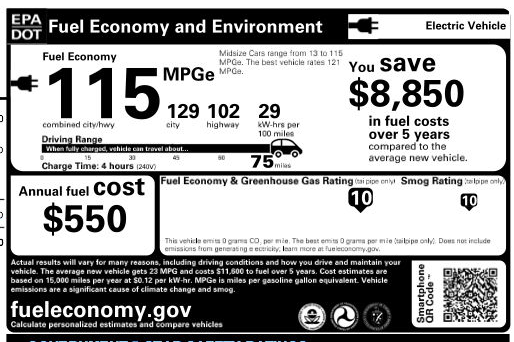
Good.  This is the official US EPA sticker for the 2013 Nissan Leaf, in black and white.

LeafEPAIt lets a U.S. consumer compare a Nissan Leaf’s fuel consumption with a petrol car, because the EPA provides a “miles per gallon equivalent” or “MPGe” figure. While this is useful, not everyone approves of the way they work it out – probably those who feel it doesn’t reflect well on their car, or petrol cars in general.  However, just to the right of that headline figure we see that, according to the EPA, a Nissan Leaf uses 29 kW-hrs per 100 miles, or 290 Watt-hours per mile.  And while you might complain that you will not achieve that in real life, the EPA calculates it in exactly the same way as it does any other fuel consumption figure you won’t be able to achieve either.  So it’ll do.

Now when our own government publishes official carbon emissions for vehicles, it does so in grams of CO2 per kilometre.  A figure of 290 watt-hours per mile converts to 180 watt-hours per kilometre – from the wall socket.  And since 1000 watt-hours of electricity in the UK emits 500 grams of CO2, we can say that a Nissan Leaf, charged in the UK, will average 180/1000 (0.18) times 500 grams of CO2 per kilometre or 90 grams.

Now 90 grams of CO2 per km is a low carbon emission number, but it isn’t “zero”.  However, even if the Nissan Leaf were a petrol car, it would still be comfortably in the zero-rated Band A for UK vehicle excise duty, alongside the most efficient petrol and diesel cars, such as the VW Golf BlueMotion (85g/km) and the Ford Fiesta Econetic (87g/km).  As it happens, the government reckons the Nissan Leaf, as a pure electric car, has zero carbon emissions and puts it in band A anyway.

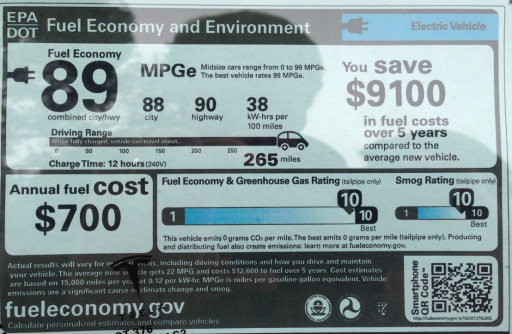
But what about the “best” electric car – the 85kWh Tesla Model S?  This can do up to 300 miles at motorway speeds, and if it were not so expensive would already be a full replacement for a petrol or diesel car for most people.  Here’s its EPA sticker, this time an actual colour photograph.

ModelSEPAThe EPA reckons the wall to wheel electricity consumption of the Model S is 380 watt hours per mile, or 236 watt-hours per kilometre.  That translates, in the UK, to 0.236 time 500 grams of CO2 which is 118 g/km.  If it were a petrol or diesel car, that would put the Model S into UK Tax band C, alongside efficient mid-range cars like the Audi A3, Ford Mondeo Eco, and some of the BMW Series 3 models.

But if the Model S has higher carbon emissions than a Nissan Leaf, does that mean it is less efficient?  No.  A Tesla Model S with a 24kWh battery would have comparable consumption to a Nissan Leaf, but its 85kWh battery enables it to go nearly four times as far, and you pay a “heavy price” (see what I did there?) for that range.  That 85kWh battery costs an estimated £12,000 and weighs about 250kg more than the Leaf’s 24kwh.  This additional battery weight has to be accelerated from rest and hauled up hills, all of which requires additional energy.  If the Model S had the same range as the BMW Series 3, it would weigh even more, and its UK carbon emissions would be greater than the BMW’s.

And this highlights an unfortunate paradox for government policy with respect to electric vehicles and their role in decarbonising transport. If all our electricity came from renewable or at least carbon neutral sources, adopting electric cars is a “no-brainer”.  But while our power generation system continues to emit fossil CO2 at its current rate we can save as much carbon by making our petrol and diesel cars more efficient, and we already have the fuel and servicing infrastructure to support petrol and diesel cars, so it will also cost less in the short term.

Meanwhile, as manufacturers strive to make closer and closer electric replicas of existing cars, they will have to increase battery sizes and their drivers will demand higher and higher powered charge points to fill them up more quickly en route.  The additional battery weight, and the additional energy needed to move that additional weight around, will increase their energy consumption and therefore – unless and until we completely decarbonise the power generation system – their carbon emissions.

Fortunately, the government plans to decarbonise the power system by 2050, by which time the transition to electric cars should be largely complete.  The transition to electric train and urban bus transport will happen well before that, because trains and urban buses don’t use batteries as much.  This makes one wonder whether in the long run we wouldn’t be better off electrifying the roads rather than weighing down our cars with bigger and bigger long range batteries.

So the bottom line is that, while our electricity grid emits an average of 500g of fossil CO2 per kWh, we can’t expect electric cars, even if widely adopted, to reduce our transport carbon footprint significantly compared with the ever-improving fossil-fuelled cars.  In fact, if electric cars start to replicate fully the performance characteristics of current cars, they will inevitably increase carbon emissions.

Meanwhile, in a completely different part of the market, there are ultra lightweight, limited range, electric vehicles that reduce the transport carbon foot-print well below that of any conventional or electric car, even when they are charged from the grid.  And since they use so little energy, they are also easier to charge from domestic renewable energy such as PV that would struggle to keep a normal electric car charged.  I have one of these, and while I can’t drive it everywhere I want to go (I can’t do that in a Nissan Leaf either) I can do two thirds of my actual trips and more than half my actual miles in it.

The Renault Twizy has a 6kWh battery and charges from the mains in 2 to 3 hours.  It can do about 50 miles in summer and about 45 miles in winter at between 35mph and 50mph.  It offers the same comfort level as a bus, but will get me from any A to any B (within range) at any time I like, with the same effort as driving a car.  It doesn’t have an EPA sticker, but my own measurements of its wall-to-wheel consumption show that it uses about 120 watt-hours per mile so even if charged from the grid emits less than 40 g/km of fossil CO2 – less than half a Nissan Leaf.  And on a good day my solar panels can comfortably re-charge the Twizy without taking any power from the grid.  On those days I really can have zero-carbon transport.

Posted in Uncategorized | Tagged , , | Leave a comment

Should a Twizy be able to charge from a 13amp plug?

Availability of public charge points is cited as key to wider take-up, but most electric cars charge most of the time at home, overnight, at domestic power levels (typically 10 amps or 2.2kW for safety reasons), and will continue to do so.  An 8 hour overnight charge at 2.2kw puts 14kWh to 16kWh into a typical electric car battery – which is less than 50 miles of motorway driving for a full electric car. This range limits the utility of electric cars, and will slow their adoption as wholesale replacements for existing cars.

There is little point in installing low power charge-points in public car parks or long distance transit routes if your goal is to extend the range of an electric car.  An 8 hour charge would occupy a dedicated parking spot for far too long to be much use and would limit the utility of the charge points.  Low power “commuter” charge points can serve the needs of a 50 miles daily commute, but you need a lot of them at or near the work place.

The range for generally affordable electric cars is now 90-100 miles achieved with batteries of 18 to 24kWh capacity.  This generation of cars does between 250 and 400 watt-hours to the mile, the higher figure being required for motorway speeds.  The most efficient internal combustion engine (ICE) cars use at least twice and in some cases four times that much energy, but typically offer ranges of 500 to 800 miles.

Battery powered electric cars will have trouble matching the current range of comparable ICE cars because they are limited by the weight and expense of their batteries.  But the range of current electric cars already exceeds the distance many of us drive without a break, and high speed (30 minute) recharging can thus support journeys of indefinite length albeit at significantly reduced average speed.

When the charging infrastructure for that is in place – as it arguably already is for the longer range Tesla electric cars – electric vehicles will still be able to enjoy the practical advantage of being able to be at least partially recharged at home over night.  Current domestic charge rates of 2.2kW only put back about 50 miles over night, but a 32 amp (7kW) home charge point could fuel over 200 miles (provided the car has a 50kWh battery – currently too expensive for most people).  An ICE car fuel tank stores 500 to 600 kWh of energy, which despite its relative inefficiency still provides 3 to 4 times the range.

The “Type 2” charging standard being pushed by industry and government in the EU has the flexibility to cope safely and securely with charge rates from 1.3 kW up to 10.3 kW.  The UK government is offering a generous subsidy on the equipment and installation cost of these charge points, which means they can often be installed in the home for little or no cost to the consumer.  This grant encourages early adoption, so may not be continued indefinitely, but we can hope that all new houses with off-street parking will one day include a Type 2 EV charge point as standard.

Doubling the size of the batteries and trebling or quadrupling the rate at which we can recharge them is clearly necessary – though it may not be sufficient – if we are ever to build electric replicas of the cars we have today.  And while electric motors are more efficient, the energy required to move a modern car, at modern speeds, and with all modern comforts is ultimately independent of the power source.  Electric replicas of modern cars are not, therefore, necessarily going to reduce the amount of energy we need to move ourselves around, particularly if the electricity comes from combustion of fossil fuel either in the car or in a centralised grid-connected power station.

If our primary goal is to reduce transport energy usage we can start by encouraging more people to walk to where they need to go if they can, or to cycle if it’s too far to walk.  This will also have health benefits, so any smart government will be keen to promote walking and cycling.  The UK government seems to have picked up this message, although tying its promotion to elite sports may not be the way to go if your aim is mass adoption.  Denmark and the Netherlands do not appear to have built their cycling cultures on the backs of Tour de France victories or Olympic gold medals, high-tech bikes, and lycra-clad cycling clubs.

But when it comes to the 85% of personal trips we currently make in our cars that are less than 5 miles – trips where issues such as range, speed, and overall comfort are less important than absence of effort – there are already very low energy electric transport solutions available.  And by very low energy we mean a fraction of the energy cost per passenger mile of even an electric car.

The electric bike – a thriving market and industry in other European countries – offers a way to get about with an acceptable level of effort for many people.  Take-up of electric bikes in the U.K., and government promotion of them, has been disappointing (although it may be improving – helped by imports of bikes and technologies from countries with far fewer cycling golds than the U.K.).  An electric bike uses a hundredth of the energy of a regular passenger car (less than 10 watt-hours per mile) and is fine for most people for round trips of 5 miles or so.

But if the effort required to propel even an electric bike is too much, or the speed is too low, the electric scooter or motor bike offers effortless travel at much higher speed and for longer distances of up to 40 miles at an energy cost of less than 50 watt-hours per passenger mile.

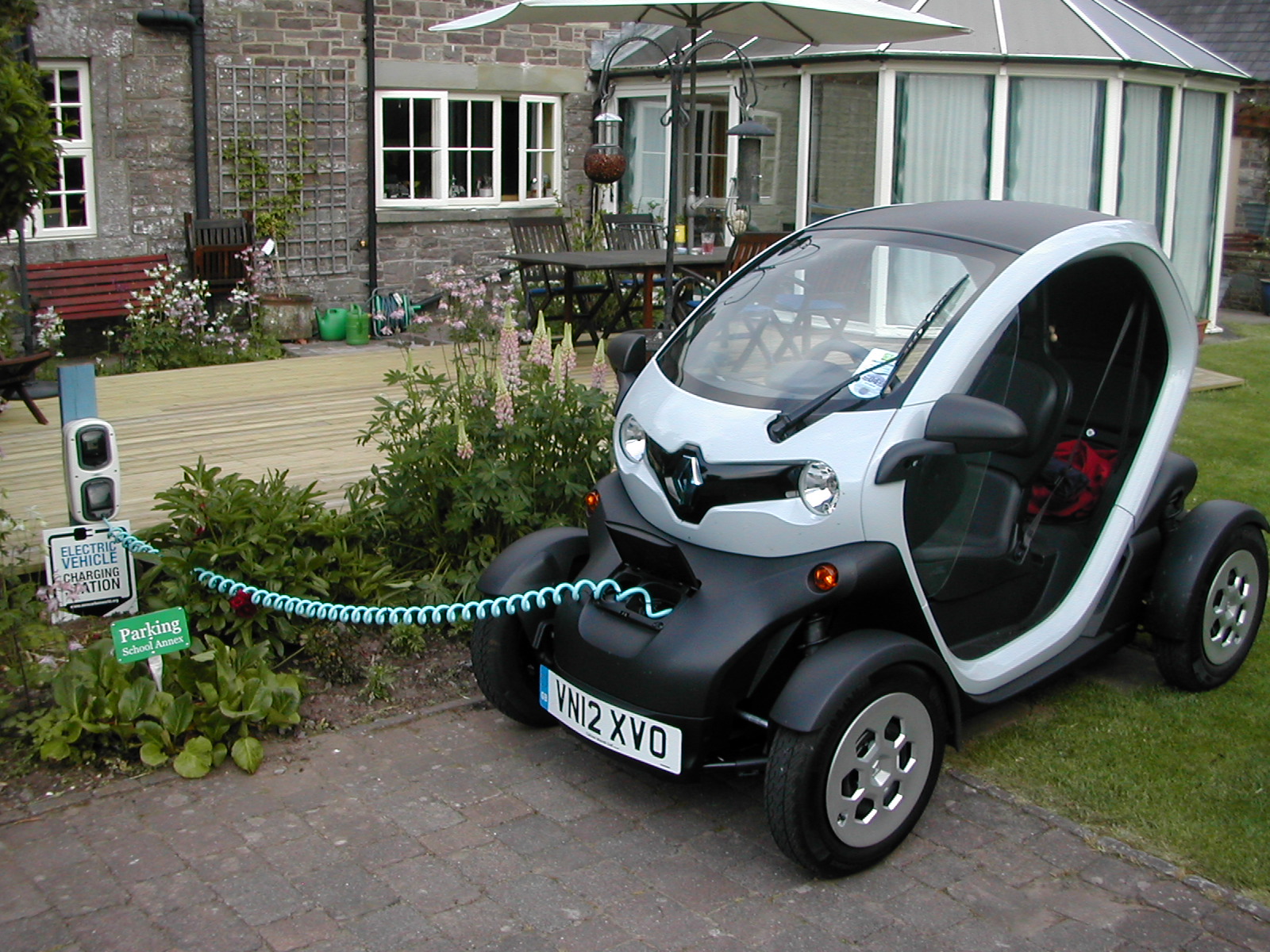
Twizy ChargingThe Renault Twizy, a particular favorite of ours at the moment, manages to move one person at less than 100 watt-hours per mile, and with its full complement of two people at an energy cost comparable with mass-transit systems like the London Underground.  It can do about 50 miles when driven at moderate speed.  This mean that it only needs a 6kWh battery which makes it very light and contributes to its energy efficiency.  It also means that it can re-charge, fully and safely, from a regular domestic power point.

An electric car, if it hopes to replace a petrol or diesel one, must offer 4 seats, luggage space, full weather protection, motorway speed and modern car comfort.  This cannot be delivered for a fraction of the all-up energy cost of a modern car, which are as efficient as we know how to make them.  The conversion efficiency of electric motors does give electric and hybrid cars an energy advantage, but a vehicle that only has to carry you a fairly short distance with limited protection from the weather – offering the facility of a door-to-door bus – can do much better.

Vehicles like the Twizy do not, by definition and design, do everything that a modern car does.  If you need something that does, you will need to buy a proper car (and today, that won’t be an electric car if you really need a car that does everything a modern car can do).  The Twizy, and ultra low energy vehicles like it, do not attempt to replace a car.  What they can do is replace a large proportion of car journeys, a third to a half of car miles, while reducing the energy used for personal transport by at least a half.

No-one has so far suggested (I hope) that electric bikes, scooters and motor bikes need special charge points.  They have small enough batteries that they can be safely re-fuelled from regular domestic sockets. A Twizy can also re-charge itself adequately over lunch (and easily over night) from a domestic power point, which makes it easier to buy and use.  It is still expensive, but even so is half the price of the cheapest electric car without the benefit of a £5k government subsidy.  It makes a good “second car” replacement even though it clearly isn’t a car, and can dramatically reduce transport energy consumption by providing the minimum necessary for effortless local travel.

We would like to see producers of the Twizy, and vehicles like it, encouraged to continue to minimise their energy use.  Designers of electric cars trying to fully replicate conventional cars will have to find ways to increase the capacity and power of their batteries. and high speed, high power charge points will be absolutely necessary for them to succeed.  When we install a full high power charging infrastructure, we can be fairly sure that electric car designs will evolve to use them to the full, with larger batteries supporting higher energy consumption on the essentials of modern car travel.

So to encourage the development of very low energy personal travel vehicles, perhaps we need to allow, or even restrict, them to re-charging from normal domestic power points at domestic power levels. This will force their designers to find ways of getting more miles out of limited batteries, and drive up the fuel efficiency of what will be a different class of personal transport vehicle. Unlike mainstream electric cars, these vehicles will not set out to replace or to replicate today’s cars, but they could replace the most energy-costly car journeys, and deliver far greater reductions in transport energy usage than simply replacing petrol cars with electric equivalents.

Posted in Uncategorized | 2 Comments

Twizyology 4 – Low energy travel – a different way of thinking

Low energy rural travel - Twizy style

Low energy rural travel – Twizy style

We own a Renault Twizy and operate a small hire fleet of them via the Eco Travel Network here in the Brecon Beacons.

Apart from being great fun to drive and a fabulous way to enjoy the hills and lanes of rural Wales, our main interest in the Twizy is its minimalism. Our Twizy has no doors or windows, carries 2 people in minimal comfort and has a top speed of 50mph and a range of 50 miles. We use it for all our local travel and have done 6000 miles in 14 months.

This directly challenges our modern Western assumptions about cars as vehicles which carry 4 or 5 people in air-conditioned comfort at 70 mph for 400 miles on one tank of fuel. We expect this even though most of our everyday car journeys are less than 5 miles at an average speed of less than 30mph and last less than 10 minutes! But this extra comfort and performance wouldn’t matter if it didn’t come at a price – energy. And unfortunately, most of the energy in modern cars is required to move the vehicle rather than whoever is being transported by it! This is still the case when the car is electric although the relative efficiency of short journeys is much improved.

The Twizy is important because it explores the opposite end of the scale. When doing a short local journey, what do you actually need? How much speed? How much range? How much comfort? – windows? doors? On a journey of less than 5 miles, for example, a top speed of 50mph versus 70 mph makes negligible difference to the journey time. And you tend keep your warm coat or waterproof on if you are only going to be in the vehicle for a few minutes and the weather outside is foul.

The result of a more minimalistic vehicle is that our Twizy uses ~100 Wh/mile – roughly half that of most “ordinary” electric cars and less Wh per passenger mile than a full bus. At such a low consumption level, charging the Twizy from local domestic sources of renewable electricity is realistic and charging from an ordinary 13amp household socket is straightforward. Indeed, Powys (where we live) could power all its local transport from its own renewable energy sources (wind and hydro), if such travel was done in Twizy-like vehicles. Our household could own a Nissan Leaf or a Renault Zoe instead but then our PV panels would cover less of their charging requirements and certainly leave us exporting less solar electricity to the grid.

Obviously, we welcome the advances in electric vehicles meaning that their performance and range edges ever nearer to mainstream cars. Our community electric Kangoo van, for example, is far superior and far more useful than our first community electric car.

However, there isn’t enough renewable electricity for us all simply to switch from combustion engine to electric cars and continue to drive in the style we are used to.  Something has to change.

We have to find ways simply to use less energy moving around and so our outlook and behaviour to car travel needs to change. This is what makes the Twizy (hopefully as a first example of a new class of ultra low energy vehicle) particularly important. Whilst electric vehicle advocates enthuse about how close to ‘normal’ car performance electric car travel is becoming, the Twizy, in contrast, explores a new and different means of local travel which uses a lot less energy but does so in a way that’s funky and fun rather than hair shirt. Its psychology is perfect in that regard.  And because behaviour drives attitude, the experience of driving such a vehicle (particularly in hilly country) makes one highly conscious of the energy required to move vehicles and bodies from a to b. Just as you resent any extra baggage you have to carry on a day out climbing a hill (because that energy difference directly affects you), you find yourself similarly resenting energy ‘lost’ on powering a heavier, higher range electric car up a local hill.

If the world simply sees the Twizy as a cheap, dispensable early step to “proper” performance electric cars, we’ll have missed something important.

Posted in Psychology, Technology | Tagged , , , , , | Leave a comment

Our Winsome Pedal project lives on

Winsome pedal boats on Salhouse Broad 2006

Winsome pedal boats on Salhouse Broad 2006

Back in 2005/2006, Swallow Boats in partnership with The Prospectory, developed a beautiful, sleek 17 foot pedal powered boat for exploring rivers and lakes in a low-effort, fun and environmentally friendly way. The project was called “Winsome” after my late aunt who always loved the outdoors and (unknowingly) partly funded a small part of the project! Swallow Boats did a fantastic job on the beautiful and highly efficient hull design and the extremely tricky technology of the engine mechanism and propellor. It was always important to us all that the boat could be pedalled with very little effort and as quietly as possible and that she looked good on the water.

Winsome at Pencelli

Winsome at Pencelli

There are 4 Winsomes in existence (mostly fibreglass) and we still enjoy pedalling ours along the Mon & Brec canal where we live to get an evening beer in Talybont on Usk. We also we make the occasional longer (overnight) trips on the Thames or Norfolk Broads. We originally got the idea for such a pedal boat from David Williams in Horning on the Norfolk Broads. He had built a version (Cyclone) for his young family to enjoy back in the 70’s.

Anyway, we were delighted to see today that the original prototype Winsome (the only one built in wood) has got a new life as a hire boat from Freedom Dayboats on the Norfolk Broads. Let’s hope many more people are able to enjoy the unique experience of “Winsoming” as a result.

Posted in General information | Tagged , , | 1 Comment

Prospectors win Green Award

The Prospectors (a.k.a. Alison and Peter) are founding Directors, along with Ian Foster of Westview Guesthouse Llowes, of the Eco Travel Network – a scheme through which local hotels and B&B’s hire out Renault Twizys to visitors to the Brecon Beacons National Park.  This week they were surprised and delighted  to win the inaugural Green Transport Award in Scotland. The plan is to use the money to pilot the design and testing of a more rugged version of the Twizy for rural areas.

A full article in The Scotsman is available here and a slightly less accurate one in the main paper here.

Posted in General information | Tagged , , , | Leave a comment

Woolly Perspectives on Art and Conservation

woollenlineIn collaboration with artists, Pip Woolf and Kirsty Claxton, we recently conducted 7 discussion groups with the varied participants and stakeholders involved in the Woollen Line Project – an innovative art and conservation project in the Black Mountains.

The groups consisted of school students, local community members, graziers, artists, horse handlers, ecologists, and National Park wardens and management and funding managers.

From a detailed analysis of the participants’ language, the report explores a variety of issues – the significance of hands-on experience, the complexities of ownership and responsibility, conflicting perspectives on a shared problem and the way an evolving, open-ended project challenges evaluation and funding structures.

You can read the research report here or learn more about the Woollen Line project here.

Posted in Psychology | Tagged , , , | Leave a comment

Putting compassion back into nursing – how does that work?

According to recent headlines, compassion has somehow got lost from NHS nursing and needs to be re-introduced. This is a difficult concept to get one’s head around especially when the Latin origin of nurse (nutrire) means “to nourish”.

If we think the problem is that our current nurses are no longer compassionate enough, we may even have the genetic tools available to test for this.  Recent findings suggest that there is genetic variation in the receptor for oxytocin which is often referred to as the “love hormone” or “cuddle chemical” because of the role it plays in social bonding, trust, empathy and generosity. Levels of oxytocin increase during orgasm and childbirth, and it helps the formation of bonds between friends, lovers, and parents and children.

Research has shown that people with two G variants of the gene are more empathetic and “prosocial,” showing more compassion, cooperation and positive emotion. In contrast, those with the at least one A version of the gene tend to be less empathetic, may have worse mental health and are more likely to be autistic.

I’m not really suggesting we implement such an employment test for would-be nurses (even if it was legal) but I’m guessing that a test of the current nursing population would show a higher percentage of the genetic variation which favours oxytocin reception than amongst the general population. And this might not have changed from 30 years ago. It certainly would be fascinating to know.

I am more inclined to think that the lack of compassionate (or nourishing) behaviour by nurses might actually be a 2nd order effect of deeper cultural and philosophical aspects of our entire medical profession. As an outsider and occasional patient and relative of patients, the critical aspects I have observed are: the absence of systems thinking, the valuing of specialism over generalism and the belief that not being able to make someone better is a professional failure.

Unfortunately, frail and elderly patients tend to fall foul of all 3! That could explain why they (apparently) suffer most from lack of nursing compassion.

The most highly paid and highly regarded professionals within the health service (and other academically inclined institutions) are the specialists – indeed the more specialist you are, the rarer you are and the more respect, status and pay you attract.

Unfortunately, humans aren’t made up of independent bits. We are complex highly interdependent systems – chemical, mechanical, emotional, mental and spiritual. Alarmingly, this systems aspect is one which doctors seem least knowledgeable about and (maybe as a result) most inclined to ignore.

For example, my late mother suffered from vascular dementia and fell and broke her hip (as many such cases do). The hip specialist did a quick and professional job of fixing it mechanically. Unfortunately, the general anesthetic significantly worsened my mother’s dementia and the physiotherapists told us they couldn’t help her to walk because “she didn’t understand their instructions”. Meanwhile the hip surgeon had a tick in his “fix the hip” records and had moved on to the next patient. My mother never walked again but, as far as we know, she remains registered as a successful tick in the orthopedics register of the hospital.

A few months later, my father was admitted to mental hospital as his emerging dementia started to produce some alarming behaviour. The care for him mentally in that hospital (and other subsequent ones) was good. They were experts on diseases of “the brain” and focussed on that. Unfortunately, they failed to notice the ulcers on my father’s legs and he soon developed MRSA. Chatting to the medical staff on his ward, revealed that they had no knowledge or capacity to deal with ulcers or MRSA and needed to transport him to a different hospital for treatment!

Perhaps most surprisingly, even “General (sic) Practitioners” seem to deal with each symptom presented by patients and each drug prescribed as an entirely independent problem each requiring a separate solution. The sense in which GP’s are generalists seems to be simply that their job is to take the symptoms presented and allocate the patient to one or other medical category which then determines which drug to prescribe or to which specialist to refer the patient.

Let’s get back to hospitals. I fear that what might be happening is that no-one in hospital is responsible for the well-being of the patient as a whole. Once the highly regarded and valued specialist has done their bit, “the rest” is left to the nursing staff as an undervalued “clean up” job which many consultants take little interest in. So, the irony is that nurses feel undervalued in this role, whilst being stuck with managing the most cognitively complex and least understood aspect of medicine! And to make matters worse, specialism has now emerged within nursing and is also equated with professional status. In the past, the highest status nurse was the ward sister and she was arguably the most generalist of the lot. Now, it is the lowest status nurse who deals with the patient’s “non-specialist” needs!

Unfortunately, elderly patients present the toughest case. The older a person, the more likely they will be suffering from more than one complaint at once and the category (or ward) that they are placed in means that only one of these complaints will be of interest to the consultant in charge. Their whole system is also more likely to be frail so, for example, not eating or drinking or moving around are all likely to have more knock-on complications. Demeaning though it might feel, their best chance is to be categorised as “geriatric”. At least that term acknowledges that there might be more than one problem for the patient.

The second issue is that the medical profession gain personal pride and public status (quite rightly) from their ability to fix medical problems, i.e. “to make people better”. When they can’t do that, they feel threatened and uncomfortable and, as a result, often lose interest in the patient and, possibly even resent their continued presence. That is a very human response. Doctors seem uncomfortable around any chronic conditions and particularly uncomfortable around terminal conditions.

I’m not sure that the staff in the much-acclaimed “compassionate” hospices are necessarily any more genetically inclined to compassion[1] but possibly they act more compassionately because they work in a culture which knows, accepts and is comfortable with the fact that it can’t and isn’t fixing someone but is “nourishing” them so the latter rather than the former ability is the measure of their personal status and value.

Unfortunately, once again, elderly patients are the toughest case. Even the ones presenting with “fixable” symptoms have bodily systems in decline – as humans we are not ultimately fixable! We are all going to die and many medical professions would rather not deal with that. It makes them feel powerless and bad. So, once again, they leave it to the less-valued, lower status nursing staff to deal with patients who can’t be fixed but are not well enough to be sent home. We even call them “bed blockers”. The medical profession is embarrassed by their inability to fix them and resents the space they take from fixable (and therefore) much more rewarding cases.

So, maybe the problem is not that nurses lack compassion but the fact that they get left with managing the most complex and least well understood aspects of medical care (people as whole systems) and/or the medical complaints which are not fix-able. These are the problems which the higher status medical specialists are themselves least competent or motivated to focus on.

To make matters worse, scientists and politicians who don’t understand a situation or know how to solve it, often resort to collecting data and taking measurements. Measurement and data collection are obviously critical aspects of any science but they are not a replacement activity! We now have nursing staff who are awarded special status as measurers. It can be more important for them to collect blood and urine samples and record them than to check whether the patient in question is dying from dehydration.

If we are going to spend money re-training nurses about acting compassionately, let us also retrain specialist consultants to take responsibility for their patients as multifaceted, complex and ultimately “un-fixable” people. One day a month working as a regular nurse on a recovery ward might be a start.


[1] That could (in principle) be tested!

Posted in Psychology | Tagged , , , , | Leave a comment