Woolly Perspectives on Art and Conservation

woollenlineIn collaboration with artists, Pip Woolf and Kirsty Claxton, we recently conducted 7 discussion groups with the varied participants and stakeholders involved in the Woollen Line Project – an innovative art and conservation project in the Black Mountains.

The groups consisted of school students, local community members, graziers, artists, horse handlers, ecologists, and National Park wardens and management and funding managers.

From a detailed analysis of the participants’ language, the report explores a variety of issues – the significance of hands-on experience, the complexities of ownership and responsibility, conflicting perspectives on a shared problem and the way an evolving, open-ended project challenges evaluation and funding structures.

You can read the research report here or learn more about the Woollen Line project here.

Posted in Psychology | Tagged , , , | Leave a comment

Putting compassion back into nursing – how does that work?

According to recent headlines, compassion has somehow got lost from NHS nursing and needs to be re-introduced. This is a difficult concept to get one’s head around especially when the Latin origin of nurse (nutrire) means “to nourish”.

If we think the problem is that our current nurses are no longer compassionate enough, we may even have the genetic tools available to test for this.  Recent findings suggest that there is genetic variation in the receptor for oxytocin which is often referred to as the “love hormone” or “cuddle chemical” because of the role it plays in social bonding, trust, empathy and generosity. Levels of oxytocin increase during orgasm and childbirth, and it helps the formation of bonds between friends, lovers, and parents and children.

Research has shown that people with two G variants of the gene are more empathetic and “prosocial,” showing more compassion, cooperation and positive emotion. In contrast, those with the at least one A version of the gene tend to be less empathetic, may have worse mental health and are more likely to be autistic.

I’m not really suggesting we implement such an employment test for would-be nurses (even if it was legal) but I’m guessing that a test of the current nursing population would show a higher percentage of the genetic variation which favours oxytocin reception than amongst the general population. And this might not have changed from 30 years ago. It certainly would be fascinating to know.

I am more inclined to think that the lack of compassionate (or nourishing) behaviour by nurses might actually be a 2nd order effect of deeper cultural and philosophical aspects of our entire medical profession. As an outsider and occasional patient and relative of patients, the critical aspects I have observed are: the absence of systems thinking, the valuing of specialism over generalism and the belief that not being able to make someone better is a professional failure.

Unfortunately, frail and elderly patients tend to fall foul of all 3! That could explain why they (apparently) suffer most from lack of nursing compassion.

The most highly paid and highly regarded professionals within the health service (and other academically inclined institutions) are the specialists – indeed the more specialist you are, the rarer you are and the more respect, status and pay you attract.

Unfortunately, humans aren’t made up of independent bits. We are complex highly interdependent systems – chemical, mechanical, emotional, mental and spiritual. Alarmingly, this systems aspect is one which doctors seem least knowledgeable about and (maybe as a result) most inclined to ignore.

For example, my late mother suffered from vascular dementia and fell and broke her hip (as many such cases do). The hip specialist did a quick and professional job of fixing it mechanically. Unfortunately, the general anesthetic significantly worsened my mother’s dementia and the physiotherapists told us they couldn’t help her to walk because “she didn’t understand their instructions”. Meanwhile the hip surgeon had a tick in his “fix the hip” records and had moved on to the next patient. My mother never walked again but, as far as we know, she remains registered as a successful tick in the orthopedics register of the hospital.

A few months later, my father was admitted to mental hospital as his emerging dementia started to produce some alarming behaviour. The care for him mentally in that hospital (and other subsequent ones) was good. They were experts on diseases of “the brain” and focussed on that. Unfortunately, they failed to notice the ulcers on my father’s legs and he soon developed MRSA. Chatting to the medical staff on his ward, revealed that they had no knowledge or capacity to deal with ulcers or MRSA and needed to transport him to a different hospital for treatment!

Perhaps most surprisingly, even “General (sic) Practitioners” seem to deal with each symptom presented by patients and each drug prescribed as an entirely independent problem each requiring a separate solution. The sense in which GP’s are generalists seems to be simply that their job is to take the symptoms presented and allocate the patient to one or other medical category which then determines which drug to prescribe or to which specialist to refer the patient.

Let’s get back to hospitals. I fear that what might be happening is that no-one in hospital is responsible for the well-being of the patient as a whole. Once the highly regarded and valued specialist has done their bit, “the rest” is left to the nursing staff as an undervalued “clean up” job which many consultants take little interest in. So, the irony is that nurses feel undervalued in this role, whilst being stuck with managing the most cognitively complex and least understood aspect of medicine! And to make matters worse, specialism has now emerged within nursing and is also equated with professional status. In the past, the highest status nurse was the ward sister and she was arguably the most generalist of the lot. Now, it is the lowest status nurse who deals with the patient’s “non-specialist” needs!

Unfortunately, elderly patients present the toughest case. The older a person, the more likely they will be suffering from more than one complaint at once and the category (or ward) that they are placed in means that only one of these complaints will be of interest to the consultant in charge. Their whole system is also more likely to be frail so, for example, not eating or drinking or moving around are all likely to have more knock-on complications. Demeaning though it might feel, their best chance is to be categorised as “geriatric”. At least that term acknowledges that there might be more than one problem for the patient.

The second issue is that the medical profession gain personal pride and public status (quite rightly) from their ability to fix medical problems, i.e. “to make people better”. When they can’t do that, they feel threatened and uncomfortable and, as a result, often lose interest in the patient and, possibly even resent their continued presence. That is a very human response. Doctors seem uncomfortable around any chronic conditions and particularly uncomfortable around terminal conditions.

I’m not sure that the staff in the much-acclaimed “compassionate” hospices are necessarily any more genetically inclined to compassion[1] but possibly they act more compassionately because they work in a culture which knows, accepts and is comfortable with the fact that it can’t and isn’t fixing someone but is “nourishing” them so the latter rather than the former ability is the measure of their personal status and value.

Unfortunately, once again, elderly patients are the toughest case. Even the ones presenting with “fixable” symptoms have bodily systems in decline – as humans we are not ultimately fixable! We are all going to die and many medical professions would rather not deal with that. It makes them feel powerless and bad. So, once again, they leave it to the less-valued, lower status nursing staff to deal with patients who can’t be fixed but are not well enough to be sent home. We even call them “bed blockers”. The medical profession is embarrassed by their inability to fix them and resents the space they take from fixable (and therefore) much more rewarding cases.

So, maybe the problem is not that nurses lack compassion but the fact that they get left with managing the most complex and least well understood aspects of medical care (people as whole systems) and/or the medical complaints which are not fix-able. These are the problems which the higher status medical specialists are themselves least competent or motivated to focus on.

To make matters worse, scientists and politicians who don’t understand a situation or know how to solve it, often resort to collecting data and taking measurements. Measurement and data collection are obviously critical aspects of any science but they are not a replacement activity! We now have nursing staff who are awarded special status as measurers. It can be more important for them to collect blood and urine samples and record them than to check whether the patient in question is dying from dehydration.

If we are going to spend money re-training nurses about acting compassionately, let us also retrain specialist consultants to take responsibility for their patients as multifaceted, complex and ultimately “un-fixable” people. One day a month working as a regular nurse on a recovery ward might be a start.


[1] That could (in principle) be tested!

Posted in Psychology | Tagged , , , , | Leave a comment

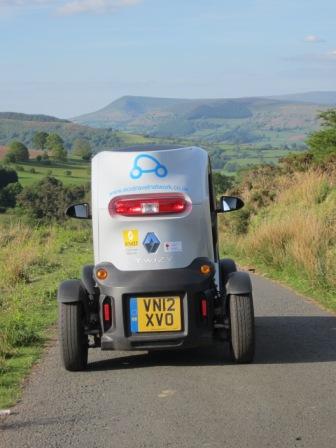
Low carbon Santa travel

A fun ending to Year 1 of the Eco Travel Network project here in the Brecon Beacons – The Prospectory’s varied life of eco projects and field trials continues….

Posted in General information | Tagged , , | Leave a comment

Twizonomics 1

A leaflet dropped through my door offering an all inclusive (VAT + installation) price of £3461 for  1.44kWp of solar PV.  I already have a 3.98kWp PV, which generated about 3000kWh in the year up to June 2012, so a 1.44kWp would have produced 3000 x 1.44 / 3.96 = 1090kWh of electricity.

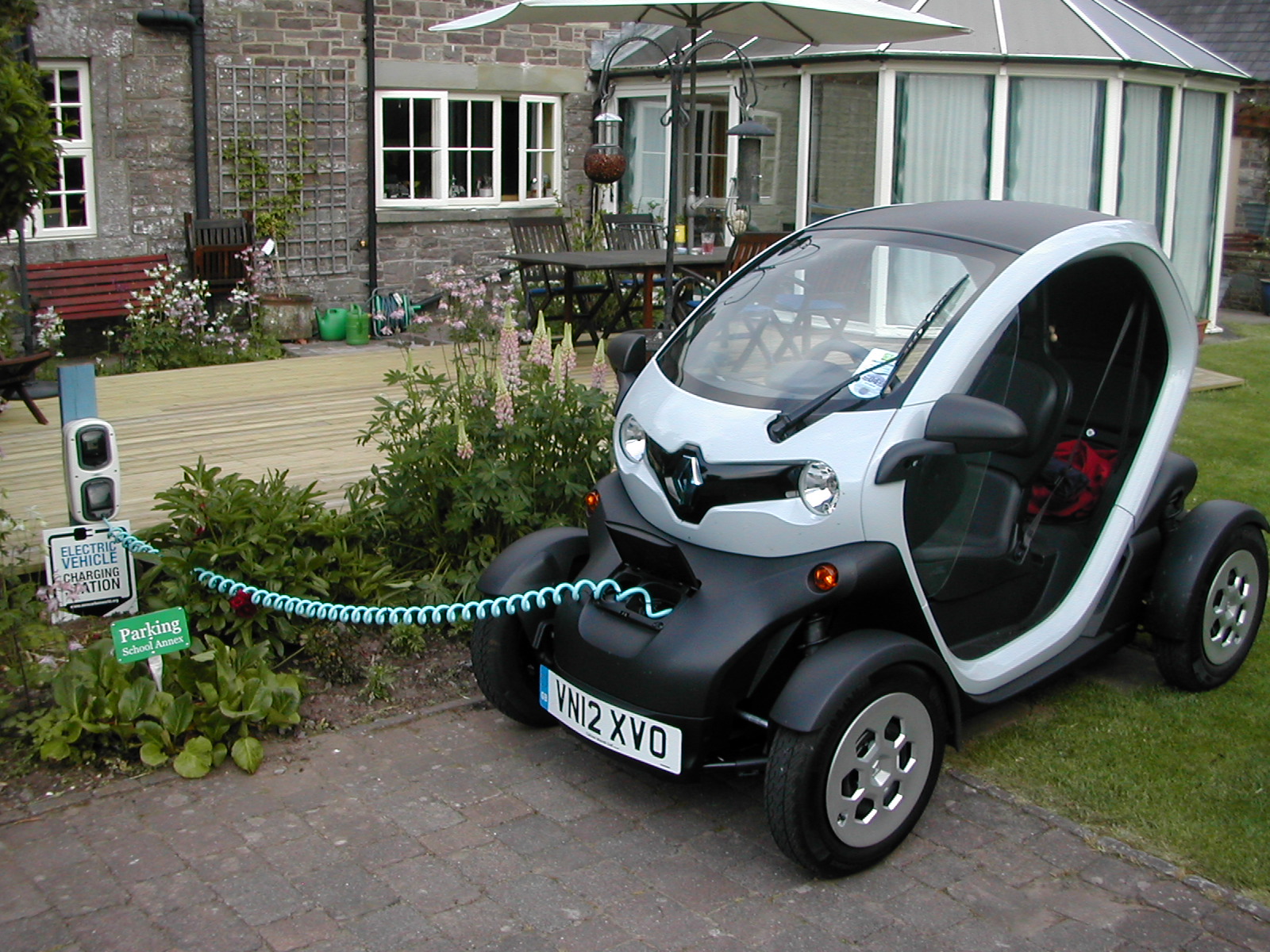
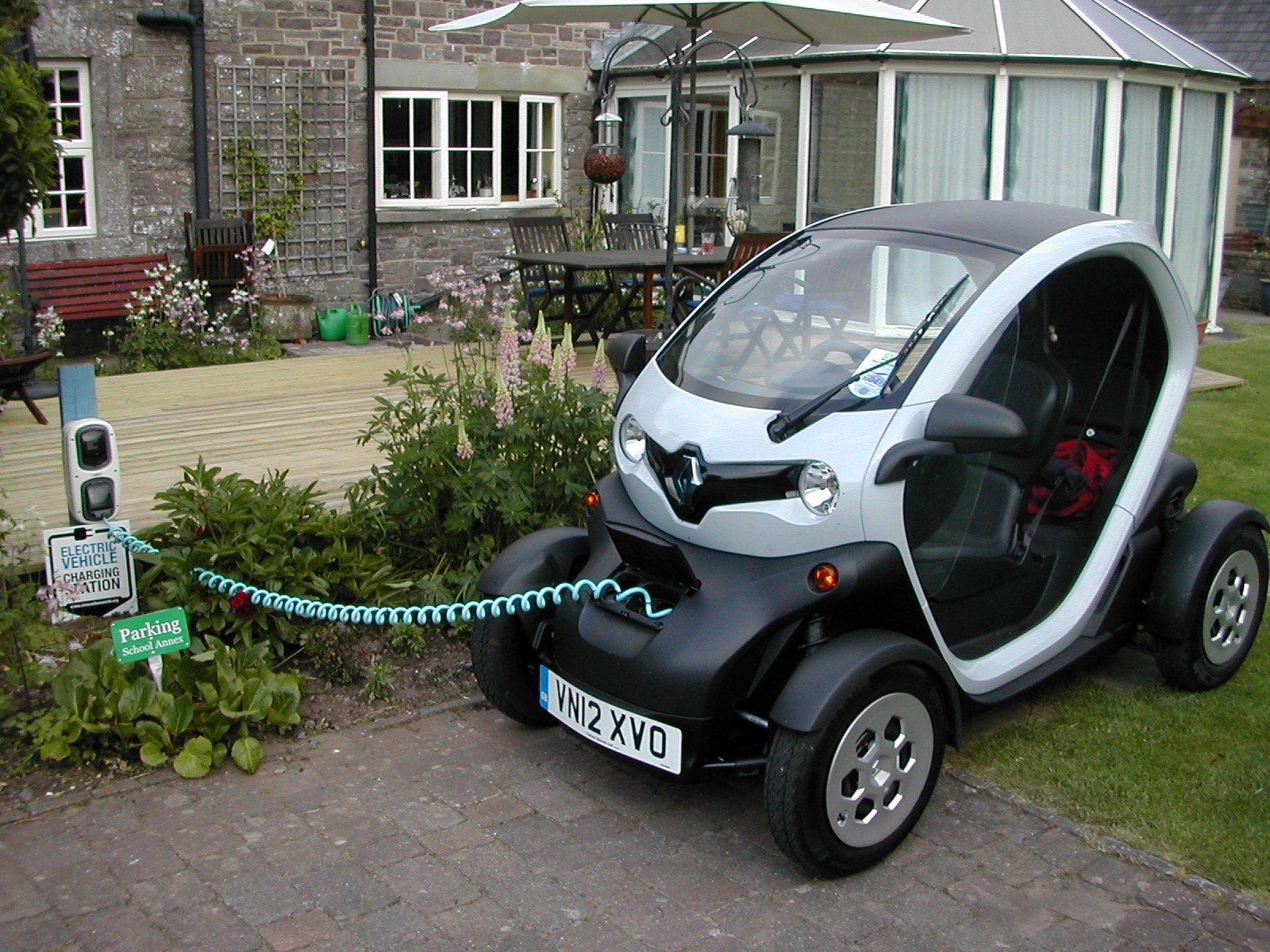
I also have a Renault Twizy.  While it’s not a “proper” car, it meets most of my local transport needs with the same speed and convenience.  Most of my personal travel, and about two-thirds of my annual mileage, is local: round trips of 30-40 miles or less.  The Twizy carries two of us for an electricity cost of about 7 miles per kWh, so 1090 kWh of electricity is enough for 7,500 miles.  This is more than we do, and more than our battery rental contract with Renault specifies.

So for the cost of a Twizy and a half – just over £10k – I can buy a “solution” to my local travel needs that offers “free fuel” and zero carbon emissions!  But what about the other running costs?

As a member of the Eco Travel Network my Twizy costs about £1200 a year in insurance, battery rental, maintenance and roadside recovery.  The cost of the electricity to charge it is about £90 a year and is relatively minor.  Using the AA’s methodology, at 4500 miles annually, our Twizy costs us 26p per mile in standing charges (excluding finance and depreciation), and 5p a mile in running costs which include fuel, tyres and parking charges.  This comes to about 31p a mile in total, and compares well with the 40p a mile the AA estimates are the costs for a small petrol car doing 5000 miles a year.

So there are both environmental and financial reasons for buying a Twizy for local trips, but by itself the financial case isn’t as compelling as fuel costs alone would suggest.

But what if we consider the running costs of a Twizy plus a 1.44kWp PV panel?

This isn’t simple to work out, because a PV system repays your investment in three ways:

1. The government-regulated “feed in tariff” (FiT) which is currently 16p per kWh generated.
2. 3p for every kWh you “export” to the grid (estimated to be half what you generate).
3. Savings on your bill for the electricity you managed to use while you were generating.

You obviously consume more electricity if you have a Twizy, and unless you manage to do all your re-charging while your PV panel is generating, that will increase your annual electricity bill by up to £90. Furthermore, a 1.44kWp PV panel, even at maximum output, doesn’t produce all the electricity a Twizy charger takes in real time.  It will, over the course of a year, put back into the grid more than the Twizy takes out, just not necessarily while the Twizy is actually charging.

The annual output of the PV panel, at 1090 kWh, will pay you £174 per annum in FiT.  The electricity company assumes you export half your production (i.e. 545 kWh) and pays you 3p a unit for it, which comes to £16 a year. And since your electricity supplier assumes that you export half of what you generate, it seems reasonable to assume that you use the other half.  545kWh, at the rate your electricity supplier charges YOU for daytime electricity, would cost you £76 per annum at the current average price.  This puts the total annual financial contribution of your 1.44kWp PV panel to £174 (FiT) + £16 (export) + £76 (reduction on electricity bill) or £266 per annum.

That lowers the annual net running costs for a combined £10k Twizy + PV package by about 6p a mile, to about 26p per mile.  This is a third less than the running cost of a small petrol car, and arguably 100% less carbon emissions.  More importantly for me is the fact that a solar PV panel, if you can afford one, provides the perfect answer to those who say that electric vehicles are a bad thing because in reality they run on coal.  While I can’t honestly claim that my Twizy doesn’t consume any coal-generated electricity, I can claim that it doesn’t require more coal to be burned to keep it running.

Posted in Technology | Tagged , , , | Leave a comment

Twizyology 3 – Indoor/Outdoor boundaries

Here is a curious psychological phenomenon.

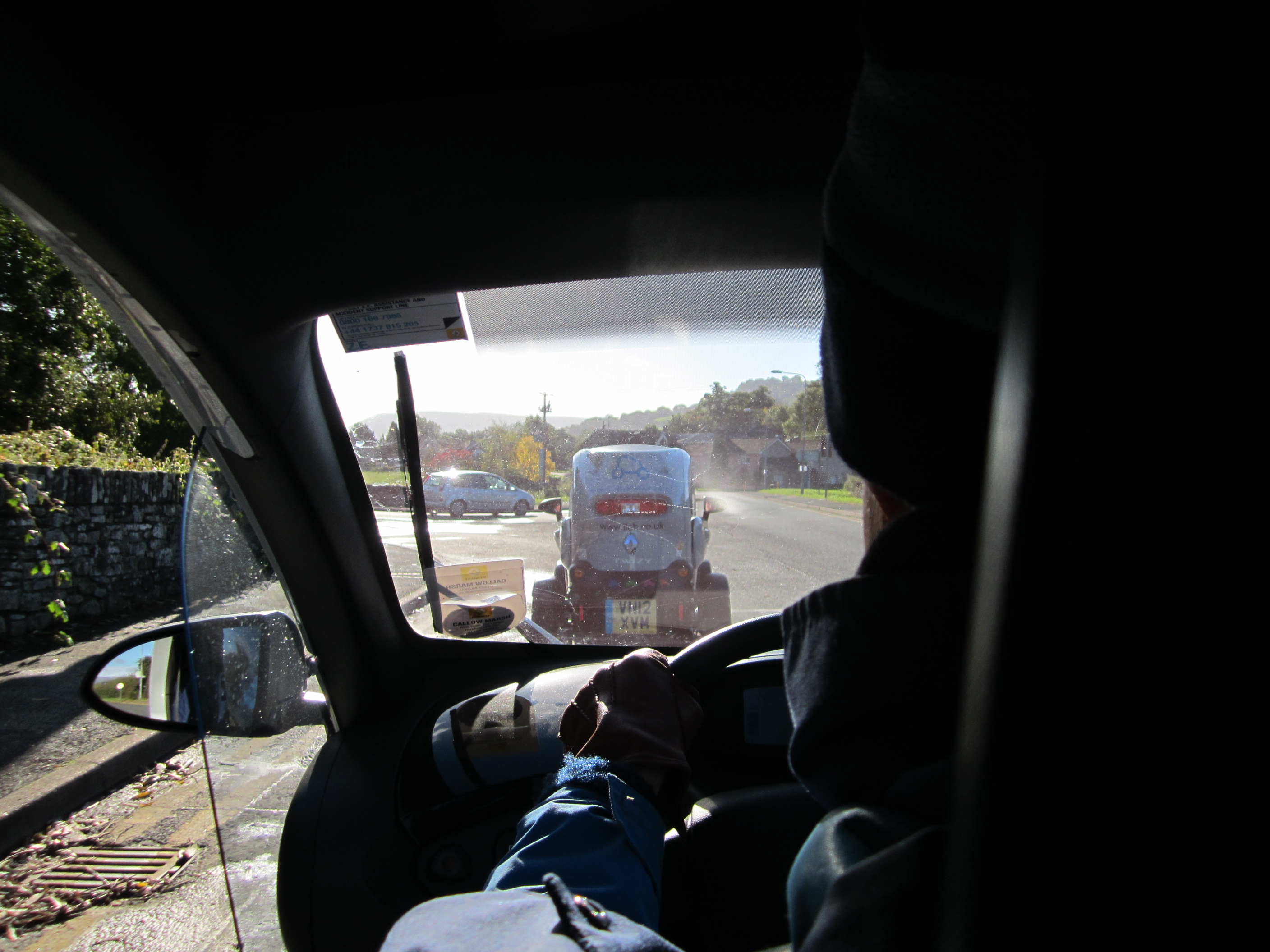
In our Eco Travel Network fleet of Renault Twizys, we have both the doorless and doored versions. Last week, we were alternating between driving one then the other in the pouring rain. The good news is that, as long as the Twizy is moving, you don’t get rained on in either case.

However, one’s naive expectation is that the Twizy with doors (even though it lacks windows) would feel comfortably drier.  But that wasn’t our perception. Unfortunately, the rain drips from the roof onto the INSIDE of the doors so the driver is close to two slightly wet surfaces which makes you want to huddle in your seat to keep away from them.  This has the effect of making the driving experience feel damper and more uncomfortable than in the doorless Twizy. Here, ironically, the same amount of wetness (in fact a LOT more) is within the same distance from your shoulders and elbows but now it is on the OUTSIDE.

Could this be something to do with our perception of inside/outside boundaries? A small tent doesn’t feel so wet if you have the door open and are watching the rain outside  than when you have to zip up completely and cower inside away from the walls….

Posted in Psychology | Tagged , , , , , | Leave a comment

The inherent dodginess of attitudinal surveys

From time to time, The Prospectory has to design and conduct surveys as part of a research project. Surveys can be useful for collecting data on behaviour from a larger sample of people than is possible with free-form interviews or group discussions. But, wherever possible, I would always favour the latter. Free-form techniques are more likely to yield useful and suprising insights and they are also a lot more reliable.

We try to keep survey questions as concrete as we possibly can having learned from experience that the less concrete the question, the less reliable the answers you get. Even when asking about concrete behaviours, it’s  more reliable to ask what people actually did yesterday or to describe the last time they did X or Y than to ask them to judge how often they do it in general.

It’s even worse when asking people in surveys to rate their attitudes to any topic. How reliable are their answers? Research suggests not very! People will happily generate and argue for any viewpoint if that is neccesary to justify something they do or have done or a position they believe they hold.

In a recent study, participants completed a survey concerning their moral attitudes. When asked to read through their responses and explain a few of them, a trick was used on 2 of the questions to display the opposite attitude rating to the one they had actually recorded whilst completing the survey.

The experiment then recorded whether particpants would detect the change or whether they would justify and argue for the opposite view of what they had stated on the survey only moments earlier. The sobering result was that 69% of participants failed to detect at least one of two changes. And they often constructed coherent and unequivocal arguments supporting the opposite of their original position. As the authors point out, the results suggest that there is plenty of flexibility in our attitudes and self-attribution and post-hoc rationalisation play a critical part in the views we hold at any point in time.

So, design and interpret attitudinal surveys with care – our brains are highly tuned at generating on the fly reasons why what we just did or said (or think we just did or said) makes perfect sense.

Posted in Psychology | Tagged , , , | Leave a comment

Woolly Perspectives

My favourite role as a research psychologist is recording and analysing the language people use when they are discussing something which I’m studying.

Our friend the artist, Pip Woolf is running a fascinating project attempting to mend a badly eroded peat bog on a local mountain top using local wool and local people. Over time, she is drawing lines of wool which look spectacular and are slowly halting the ongoing erosion.

On the last trip up the mountain, I took my digital recorder to try to capture how different volunteers  understood or related to the project. Here is the result.

I like the fact that some people talked about the ecological and artistic aspects of the project. Others compared it with other much more “high-tech” projects elsewhere. But for others, it was simply enjoying the horses or hammering in the pegs to hold the wool, the stunning scenery or the chance to meet new people.

People won’t necessarily engage in sustainability projects for sustainability reasons – they may simply do so because it’s fun or different or sociable. I like it.

Posted in Psychology | Tagged , , , , , | Leave a comment

Twizyology 2 – when is a car not a car

As previously, noted, we think the Renault Twizy’s greatest strength is in the fact that it’s not a car – it offers something completely different and fun for travellers who just want to get short distances cheaply and using very little energy. Perfect, for example, for the hilly rural area where we live and work where many people’s journeys are less than 5 miles but up and down very steep hills to the nearest village or town.

We also think that the Twizy’s “not-carness” gives it a chance of disrupting the car market in a way that more conventional electric cars are struggling to do (because they automatically get compared unfavourably with the existing market products).

The most obvious symbol of the Twizy’s not-carness (or so we thought) was that it didn’t bother at all with doors thus making a statement about the kind of short journeys it expected to make. It appeals, for example, to people who might cycle but don’t want the physical effort (especially on our hills) or people who might use a motor scooter but are nervous of driving a two-wheeler and don’t want to get soaked in the rain. The fact that the basic Twizy is completely open-sided makes a statement – this is not trying to be your average car. Think differently! You won’t expect to go far in this, you will need warm clothes and a hat in winter and it’s obviously not intended to be your main car or carry you long distances. Of course, on sunny summer days, it’s delightful to drive along open to the elements especially on our country lanes and open hillsides. But come winter, don your warm coat and hat (which you will need anyway when you get out of any car) and whizz along the few miles to work or the shops. The good news is that you don’t get wet even in our open-sided version – well not until you stop!

But, we discover that most people are choosing the Twizy with doors option. And then unfortunately, psychology cuts in. If you have doors, it feels odd (when it rains) not to have windows which you can close. I have driven both kinds of Twizy in the pouring rain and it certainly feels odder in the doored version not to have windows – I almost found myself reaching out to close them. In our own, open-sided version, it might be pouring with rain just beyond elbow reach but the concept of windows doesn’t cross your mind – how could it when you don’t have any doors?!.

So, maybe inevitably, just months after the Twizy is released, there’s already an add-on accessory of windows and now as autumn approaches, the Twizy owners with doors and windows have started discussing heaters!! Again, the advantage, if you will, of our open-sided version, is you can’t really discuss heaters!

A few Twizy owners are thus turning their vehicles step by step into ‘proper’ cars and the risk is death, effectively, by focus-group-think of a winningly different concept for local, low-energy travel. I hope I’m not right and I also hope those Twizy owners who seemingly really want a car realise that and buy themselves a small, conventional electric car instead.

Once people think of Twizys as proper cars, they lose their challenge to our car-centric mindset. They will start to be compared with small “proper” cars and may risk being written off as somewhat inferior – unless of course padded seats are introduced, proper doors and windows and a greater speed and range. Then, hey presto, you have small quite pricey electric car just like the other small electric cars on the market. We have one such as a community electric car – it’s functional but it offers nothing new or different and is certainly unlikely to challenge the existing market.

The Twizy, as envisaged by Renault, is a challengingly different travelling concept for short journeys. It says something different and offers different values and thereby disrupts our assumptions about car travel and energy. I hope that Renault has the courage to stick with their original idea.

Posted in Psychology | Tagged , , , , , | Leave a comment

Solar miles

As you may have spotted, The Prospectory has a strong interest in the relationship between energy and travel – from both a technical and psychological perspective.

We are interested in how we can all move around using a lot less energy than we currently do and where the energy we require to move us comes from.

Here in the Brecon Beacons, we are lucky to be able to generate a lot of our energy from natural, local sources – mostly rain, some sun and (outside the National Park at least) wind.

The Prospectory itself has a 4kW domestic PV installation and we run a Renault Twizy, “Thierry”, as our own domestic vehicle and in our capacity as Directors and promoters of the Eco Travel Network scheme.  Although Thierry can only sometimes charge directly from our PV panels (he tends to recharge a bit too fast), we were curious to know what percentage of the miles he has transported us over the past 2 months (July and August) was effectively generated by our own PV – i.e. pure solar miles.

In those 2 months, our PV panels have generated 722 kWh and according to the stats on our energy use per Twizy run, Thierry averages 8 miles per kWh so, in total, the PV panels have generated 5776 potential Twizy miles. And Thierry, in that time period, has actually travelled 1022 miles. His daily average is 21 miles. (Interesting to note that the national UK average is 23 miles car miles per day – so much for range anxiety!!).

And, rather intriguingly, this is what it looks like on a daily basis over July and August (which were certainly not the sunniest months on record) but each day, there were plenty more solar miles we could have done! And the sunnier it is, the more enjoyable it is driving in an open car.

Travelling green is OK but travelling yellow is a lot more fun!

Posted in Technology | Tagged , , , | Leave a comment

Twizics 3

Twizics 2 identified air resistance as a major energy drain at high speed, but changing speed also uses energy.  If there were no air, drive train or tyre drag, we could maintain a constant speed with little or no energy input, but accelerating and changing direction always takes energy.

Acceleration increases kinetic energy, so you can work out how much energy you need for a given change of speed of a given mass. What’s not so easy to work out is how much we accelerate in the course of a given trip.  Driving at high speed usually involves more acceleration and braking, but it’s hard to quantify.

The lower your top speed, the less energy it takes to achieve it, and you also lose less energy when you brake.  But should you accelerate gently to your top speed or is it best to accelerate hard?  The energy to accelerate a given mass between two given speeds is the same no matter how long it takes you to do it.  But the harder you accelerate, the higher your average speed will be over the course of your trip, and that increases the energy used to combat air resistance.  So although you will spend less time combating that air resistance if you accelerate quickly, you will use proportionately more energy.  So to maximise your range it is best to accelerate gently to your chosen speed and then try to maintain it.

Braking reduces kinetic energy. In a Twizy you get some of this energy back if you slow down using the regenerative braking of the motor rather than the friction pads of the brakes.   Friction just converts the kinetic energy into (wasted) heat, while regenerative braking converts some of it back into chemical energy in the battery.  But unless we’re going to stay still, we have to accelerate and decelerate to get anywhere, and you can’t really work out theoretically how much energy you would use on an average trip.

The other big consumer of energy around here is hill climbing.  Once again, the physics is straightforward: it takes a given amount of energy to raise a given mass against the force of gravity, regardless of how long it takes.  But again, the faster you climb the more energy you consume overcoming air resistance.  Also, you will need more power even though you need it for less time, so if a hill is very steep, the Twizy’s motor may not be powerful enough to climb it at full speed.

The bottom line is that it is difficult to predict how much energy a Twizy will use on a given trip unless you know the terrain and the speed at all points of the journey.

In an attempt to construct an empirical model, I used a log of a trip I did last year in a fully instrumented electric vehicle. The log records the position (longitude, latitude and altitude) every 5 seconds of a vehicle being driven conservatively along a gently undulating 10 mile route at a maximum speed of 25mph and an average of 16.  I did the same trip rather more quickly (maximum speed 35mph average 21) in a Twizy and I know how many Watt-hours of energy that took.

Using this data set I can calculate the overall power consumption by applying the various parameters (drag coefficient, cross-sectional area, rolling resistance, drive train drag, vehicle and occupant mass, gradient).  I do not know the true parameter values in all cases, so have made credible estimates.  There are several combinations that will produce a “right” answer – i.e. one that corresponds to the actual recorded power consumption on this trip in a Twizy – but the tuning process enabled me to establish which ones are most sensitive.

I then used this “model” to calculate the expected energy consumption for the same trip conducted at a range of “maximum” speeds.  The graph below shows the (very simplified) result.  Here’s (roughly) where I think the energy goes on a typical ten mile Twizy trip in gently undulating terrain in mid-Wales.

This fits our actual consumption of about 125 Watt-hours per mile at the sedate speeds at which we drive, and the more exciting 170 to 190 Watt-hours per mile that we get when we’re showing off, and all our friends seem to get most of the time!

Posted in Technology | Tagged , , , | Leave a comment