The endless joy and stimulation of working as an experimental psychologist with visual artists….
Larks & Ravens has just run our first experimental Pie Supper at https://bricksbristol.org/ We invited 4 guests to use art and sharing a pie supper to generate conversations about how to divide a pie in a fair way. Politicians and economists often talk about “growing the pie” so everyone gets “a larger slice” – but does that actually happen? How do you divide a pie fairly? What happens in your home? Who deserves (or doesn’t deserve) what size of slice and why??
It certainly stimulated convesation. I’m looking forward to the next one.
We are delighted to announce our first ‘I’ve got an Idea’ Fund award of 2023 to Dr Ramneek K. Johal, a research scientist in the fields of biomaterials and regenerative medicine. As well as working on defined projects, Ramneek likes experimenting in her own time to seek novel solutions to the problems encountered in the lab.
Collagen I is one of the most abundant proteins found within the human body. Its role is two-fold: to provide a suitable framework (mechanical strength) for tissues and to foster cell attachment and function. Bovine and human collagen I are highly conserved at the molecular level and bovine collagen is widely used in tissue engineering due to its low price and abundance. It is particularly useful for the development of scaffolds for soft tissue repair and regeneration such as skin.
Skin provides a mechanical barrier to the human body protecting against invading pathogens and the elements. Damage to the skin can occur and in the UK ~ 175,000 people attend Accident and Emergency with burns and scalds every year (www. cks.nice.org.uk). Thus, there is a need for engineered replacements/scaffolds that mimic the skins naturally complex 3D architecture.
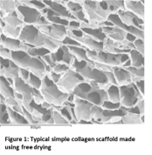
There are a number of techniques that can be used for the manufacture of 3D scaffolds including ice-templating. This is a technique whereby a suspension of collagen is frozen, with ice crystals forming a labyrinth like architecture (Figure 1). The collagen is trapped at the ice crystal boundaries, and when the ice is sublimated using a freeze drier the collagen is left behind forming a porous scaffold. Many factors can influence the scaffold architecture including the freezing temperature, rate of freezing and the shape of the mould. Currently, the moulds are made by the lab’s workshop, however they are both time-consuming and expensive to manufacture. If a mould doesn’t correctly influence the geometry and pore size of the current scaffold, it’s back to square one in terms of design and manufacture (with added expense!).
Ramneek’s idea is to use cheap, everyday household items such as tea light holders, plumbing fittings, small toys and baking trays as moulds. By varying the freeze-drying temperature/freezing rate she will be able to determine how these everyday moulds influence geometry, pore size and porosity of collagen scaffolds. Scanning electron microscopy will be used to visualise the formed scaffold interior. The data produced by this project will help both academic and industrial researchers in the development of novel (and potentially cheaper) scaffolds for tissue regeneration. We wish Ramneek well in her novel experimentation.
We are proud to continue to fund a fascinatingly wide diversity of technical ideas.
In terms of domestic heating, the UK faces a major challenge from the combination of fossil fuel reduction, the rising cost of energy and our poorly insulated housing stock. We need to find ways to keep people comfortably and affordably warm in a diversity of housing without wasting energy.
Infrared (IR) heating is one option. Instead of heating the air, IR panels heat the occupants directly along with the thermal mass of the room (walls, ceiling, floor and furniture). This mass absorbs the heat and radiates back into the room which gradually warms the entire space.
Given that IR heating is decentralised and heats people directly, what difference does that make to people’s thermal comfort and their home’s energy efficiency? To address this question, I interviewed 20 UK households who have IR as their primary source of heating. You can read the results here.
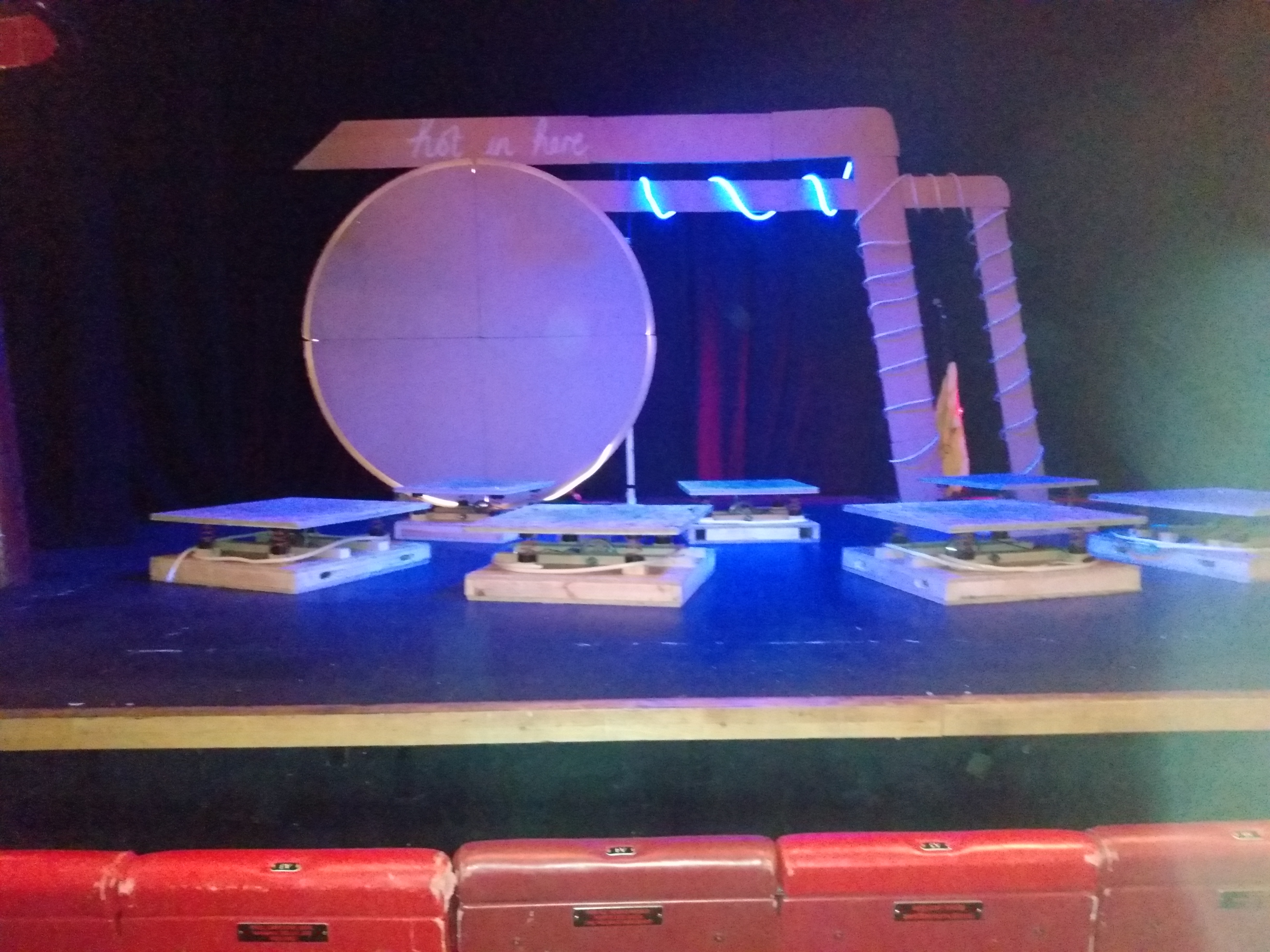
Thoroughly enjoyable visit to Bath this week to meet Pigfoot Theatre and see their energy harvesting dance floor tiles (funded through our ‘I’ve got an idea’ fund) in action in their powerful & joyous ”Hot in Here’ performance. Well done Pigfoot Theatre for their innovative idea of floor tiles at low cost which can easily be transported and configured to new locations. ‘Hot in Here’ is current on tour around the UK.
This month, I’m interviewing 20 UK households who are heating their homes with Infrared heating. How do they use it? How well does it work for them? How much energy does it use?
As an experimental psychologist, I’m trying to unravel the complex interrelationship between (a) people’s thermal comfort, (b) types of domestic heating (radiant, convected, conducted) and (c) energy.
My motivation is how we can keep individuals (who are wildly variable in both physiology and behaviour) comfortably warm in houses (which are wildly variable in size, age and energy efficiency) without wasting energy or money. I think the clue may be to switch thinking from heating space to heating people.
The research follows on from the trial I ran exploring person-centred and hybrid methods of heating in rural Welsh homes earlier this year.
Thank you to the Herschel customers who are helping me with this research and Herschel Infrared for enabling it to happen.
It would be interesting to do a similar set of interviews with heat pump households.
My findings will be published on this website in December.
I thought this guide might be over simplistic but actually it makes some very useful points and I strongly recommend a read. I certainly was reminded of mistakes I’ve made in my multiple research projects over the years.
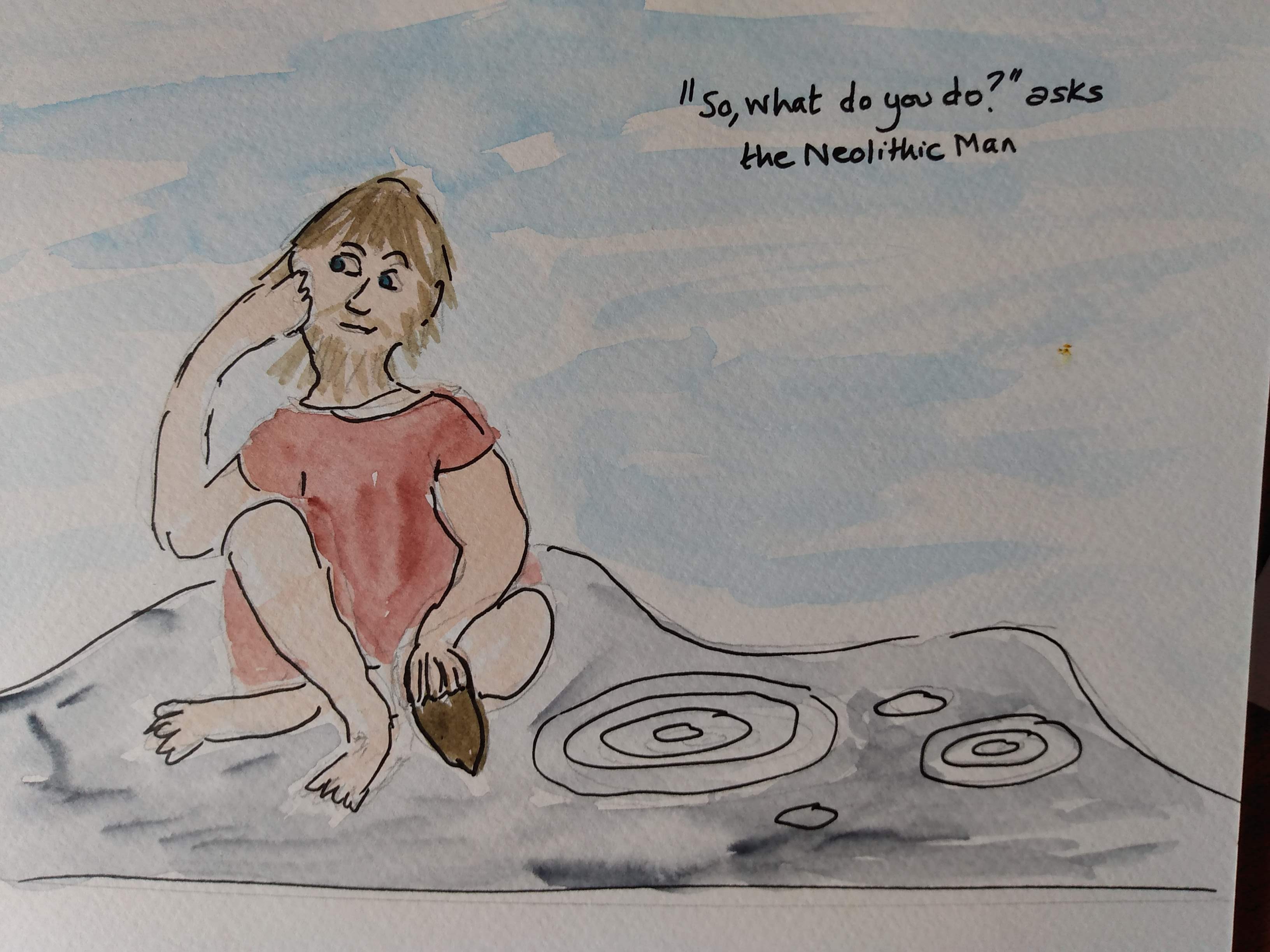
Inspired by exploring neolithic cup and ring markings on rocks around Argyll
Listening to the Radio 4 Today programme this morning, someone was being interviewed about the current problem of high job vacancy rates partly as a result of the growth in “inactive” people following the Covid epidemic. “Inactive” it seems has become a shorthand for “economically inactive” which the government defines as “A person of working age who is out of work. not actively looking for work. not waiting to start a job or not in full-time education“
The first thing I’d like to know is are these, so-called, “inactive”, people actually inactive or just carrying out activities not in return for money or the value of money – the definition of economically inactive and the only value that GDP measures.
Even as an advanced Western, market driven, economy, we all recognise the things which make our lives happy, meaningful & worth living, e.g. love, health, discovering, learning, playing, conversation, creating, making things, growing things, walking, singing, reading, art, music, surprises, sensations, imagination, laughter, pets, our natural world, eating together…. And we all recognise that these things can’t easily be assigned a monetary value. But, paradoxically, our market driven, capitalist economy only values and incentivises those activities to which it can assign a ££ market value and count as contributing to GDP. People not engaging in one of those are currently counted as “inactive”- an implied negative.
Albert Wenger, in his book ‘Life after Capital’, argues that we have lost sight of the value of “non-economic” work – work that is about taking care of people and our planet, living happy, meaningful lives, creating a better more enjoyable world through art, music and drama, building vibrant communities, etc. As he says, there are vast swathes of problems that markets cannot and will not solve and opportunities it won’t create. Wenger asks “how do we grow this “non-economic” sphere?” i.e. grow those activities which directly contribute to our own, others or society’s wellbeing and sense of purpose without consideration of personal financial gain? When these things we create or services we provide aren’t produced for the market, their evaluation doesn’t count.
So, maybe many of the people who left their jobs as a result of the pandemic are indeed highly “active” and contributing joyfully and meaningfully to that much needed non-economic sphere. Could Universal Basic Income be the way to grow this? It requires a total rethink of our market and job led economy and, sadly, no politician of any party seems to be even thinking about this.
“William Blake knew what we all eventually realize, if we are awake and courageous enough: that the best way — and the only effective way — to complain about the way things are is to make new and better things, untested and unexampled things, things that spring from the gravity of creative conviction and drag the status quo like a tide toward some new horizon…..
True politics are not ideologies to discuss, but an attitude to your relationship with the world which is enacted in your daily life. Your politics are not what you tell yourself you believe. They are not the set of ideas that you identify with, or look to for personal validation of your goodness as a human being. Your politics are expressed in the choices that you make, the way you treat other people, and the actions you perform. It is here that hypocrisy and vanity fall away, as the reality of your politics is revealed in the countless decisions that you make every day.”
Worth reading the whole article – a welcome counter to Rishi Sunak’s focus on the “earning potential” of any education.



 The Prospectory