
Challenging our perceptions

I’ve always enjoyed optical illusions. And every now and then, it’s good to encounter a  new one.

The two spirals above are exactly the same colour – i.e. they are both  green (as shown on the right). It’s hard to believe it but there it is. The ‘blue’ appearance is simply our visual system calculating colour relative to immediately adjacent colours.

It’s healthy to be reminded every now and then that we happily interpret the world around us every day – scenes, events, conversations, motivations, emotions – but actually all these our interpretations are similarly affected (distorted even) by context.

Never be too certain…..

Posted in Psychology | Tagged | Leave a comment

Attitudes or Behaviour – which drives which?

The age old psychology question – do attitudes drive behaviour or does behaviour drive attitudes? Whichever model you favour, it seems clear that there’s a pretty complex interaction between the two.

We favour a research approach which starts with behaviour. We introduce new technology into people’s lives which has the potential to disrupt established habits and encourage experimentation – ways to do things differently. We then explore how people’s attitudes (and subsequent behaviours) are changed by the experience. It’s certainly easier than trying to persuade people to change their attitudes and it’s a lot more interesting and fun for everyone involved!

But here’s an interesting behaviour/attitude case from our current b-bug trial. We are loaning tourists a road-legal electric buggy for 3-5 days of their stay in the Brecon Beacons and monitoring the use they make of it and what they see as its potential value compared to a car.

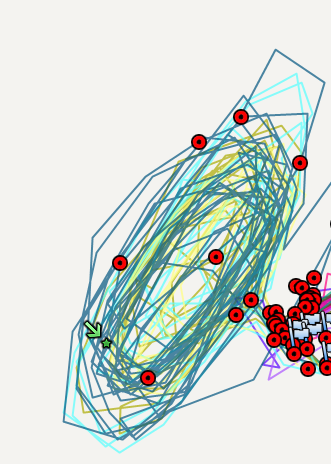
Subject 1 (a motoring journalist from a National newspaper as it happens) had a b-bug for 4 days of his holiday. Here is the Satellite track of 15 of the 20 miles he did in the b-bug during his stay. The location was the field adjacent to the holiday cottage.

15 miles b-bug track in a 3 acre field

And his feedback at the end of 4 days? – “I’m afraid I don’t get the point of this vehicle”.

Here is a more typical subject from our trial (a lady in her 30’s camping with her partner). She had a b-bug for 3 days. Here is the satellite track of the 50 miles driven during their stay.

50 miles b-bug track from Priory Mill campsite

And her and her partner’s feedback at the end of 3 days?  “the b-bug made our holiday… we would have gone to places but the b-bug made going short distances worth the trip … it turns going somewhere into an event, doesn’t it. We loved it. It really did make us go out a bit more than we would have done otherwise

So, did Subject 1 think the b-bug was pointless as a vehicle so he only drove it round in circles on a field or did he only drive it round in circles on a field and therefore decide it was pointless?

And did Subject 2 think the b-bug was an interesting alternative to a car and so use it to explore the area and get to the pub each evening or did she drive it 50 miles to explore the area and get to the pub and therefore decide it was an interesting alternative to a car?

Curious, huh?

Posted in Psychology | Tagged , | Leave a comment

Who takes part in technology trials?

In running trials of a new technology, one always hopes to generate a neat profile of the type of person who will value and use the technology in question.  But it never works out quite like that. In every technology trial we’ve ever run, we end up with a mix of the following types of people involved. The first 3 types are the really valuable ones – you can learn all sorts of useful things from them.  The last 3 types contribute little but they always turn up in the mix.

The innovators – these people grab the technology and start using it for all sorts of interesting things – including things you’d never thought of. They are gold dust and you always get a few of them and they are more often women than men.

The collaborators – these  people use the technology, see its value to them and then start working enthusiastically with you to improve the design because it’s now in their interest that the product is successful. Creating a set of these “informed users” is one of the most useful aspects of running a trial.

The accidental bug finders – these people unerringly find any faults which are  lurking in your prototype system or user model. They don’t mean to and are very apologetic when something suddenly “doesn’t work” or “breaks” or they “can’t remember which button to press”. They think, unfortunately,  it’s their fault but it isn’t, it’s yours. Value these people as they’ll save you a lot of time and money further down the track!

The passive anoraks – these are the self-styled technical experts who don’t actually use the technology (or even volunteer for the trial) but they hang around the fringes, asking endless technical questions and telling you about faster/better/cheaper ways it could have been designed despite never having built one themselves. They are the most irritating and it’s rare to learn anything from them.

The active anoraks – techie enthusiasts who will sign up to try any new technology! They’re much more fun than the passive anoraks but they don’t tend to provide very useful data or insights. They are so focused on the technology, they can’t think what to actually use it for!  And they are so enthusiastic, they overlook the faults.

The non users – this is perhaps the strangest set but we always encounter a few in any trial. They enthusiastically sign up for a trial but never actually do anything with the technology once they get it. And, unfortunately, it’s never very clear why! Just odd.

One is left with an uncomfortable feeling that, if you were to use exactly the same individuals for every technology trial, however diverse the application, the same people would fall into the same categories every time!


Posted in Psychology, Technology | Tagged , | Leave a comment

Technology, people and paradoxes

As a cognitive psychologist, brought up on a diet of strictly controlled lab experiments,  I love the “totally out of control” nature of technology trials (although not always at the time!).

However well you plan the trial or design the artefact in question, novice users will surprise you. They’ll use the device for things you’d never thought of (and certainly didn’t design for), they’ll extol the virtues of things you considered incidental whilst taking for granted the features you were most proud of. And finally, they’ll develop their own idiosyncratic model of how the thing works (however good your Technical Guide).

Women are the most rewarding in this regard because, if you can persuade them to take part in a technology trial in the first place (not always easy),  they are excellent at discovering what the technology is most useful for – partly, it seems, because they take little interest in the technology itself but only what it enables them to do.

And then there are the paradoxes which emerge.

When we ran trials of simple information appliances, we found that the less any appliance did, the more uses people found for it and vice versa. That was a tough lesson to convey to a lab full of eager feature-focused engineers.

In our current b-bug trial, we are loaning two electric, road legal buggies to holiday makers in the Brecon Beacons. Two paradoxes are emerging so far from this trial:-

1. People remark that recharging the electric b-bug (which takes about 6 hours) is “quicker and easier“(sic) than filling their car at a fuel station (which takes, say 10 minutes).

We think this is because (a) charging the b-bug just requires a 13 amp socket and everyone has got one of those and (b) people tend to charge the b-bug (or any electric vehicle for that matter) overnight – i.e. whilst you are busy doing something else whereas filling your car at a fuel station is always 10 minutes out of your time. Here in rural wales, the nearest fuel station can even require a 30 minute diversion.

2. People (on holiday) remark that with the b-bug “they don’t need to drive so far because the journey is more interesting“. I’m not quite sure what the psychology is here. It needs some thought.

I am reminded of someone we interviewed some years ago about why they were planning to swap their motor boat for a sailing boat (even though they didn’t know how to sail). Their explanation was that motoring was pointless without a destination whereas “people sailing seemed to have a lot more fun going nowhere“!

Posted in Psychology | Tagged , , , , | Leave a comment

Welcome to The Prospectors’ Blog

Welcome to The Prospectors’ Blog.

Archived posts from this blog over the past 5 years can be found at ‘Fresh from the Pan‘.

Posted in General information | Leave a comment