Twizyology 1 – the Psychology of the Renault Twizy

We haven’t blogged much recently as we’ve been busy launching a new, not-for-profit company, The Eco Travel Network Ltd which grew out of our b-bug project which The Prospectory ran last year.

The aim of the Eco Travel Network (ETN) is to enable visitors and residents of the Brecon Beacons National Park to travel around in lightweight, low energy vehicles – powered by electricity generated by local solar, hydro and wind.

With the support of the Sustainable Development Fund  and Renault UK, the ETN has purchased a fleet of 7 Renault Twizys which it is leasing to accommodation providers in the National Park for them to use themselves and rent to their visiting guests to replace journeys they would otherwise make by car.

Now, the scheme is launched, we are starting to refocus on The Prospectory’s original research interests in the ETN project.

Here are our behavioural research interests:-

1. The Renault Twizy as a ‘not-car’

From a Prospectory perspective, the most interesting thing about the Twizy is that it’s not trying to be a car.  It offers something different– a small, lightweight, open-sided, low energy runabout. We think the Twizy’s “not-car-ness” might give it a better chance than other electric vehicles of disrupting the existing car market. Why? Because conventional electric vehicles are having to compete with petrol and diesel cars on speed, comfort, range and all the well-established values of the existing car market which auto journalists use to evaluate new offerings and customers expect when they buy a car.  That is difficult for electric vehicles to achieve at the moment and impossible in the same price bracket.

Established technologies tend to be disrupted and eventually replaced by new technologies which, at their outset don’t perform as well along existing dimensions of value but offer customers new and different values. Digital cameras are an example. The first digital cameras were heavy, more expensive and delivered much poorer image quality but people found they could do different things with them. Digital cameras have now caught up on image quality and price and almost completely replaced traditional film but they have also radically changed the way we do photography.

The Twizy makes a statement that it is NOT a “proper car” – it is open-sided, unheated, tandem-seated and ridiculous for travelling long distances in but, at the same time, it’s nippy, cheap, handy and fun for the 85% of journeys which are under 5 miles.

So, from a research perspective, we are interested to gather feedback from our Twizy users to see if people do think about the Twizy differently, travel differently with it and whether it helps disrupt the established dimensions of the car market.

Or do people think it’s an under-specified car and start to demand it has doors, windows, heaters, more comfortable seating and a greater speed and range. We have noticed that auto-journalists are the first to view it that way and, sadly, the industry is already offering Twizy windows as an accessory. The jury is out.

2. Changing attitudes by changing behaviour

We could attempt to educate people that they don’t need a car with a performance spec (speed, power, comfort, range) to take them 400 miles to Scotland simply to nip 2 miles down the road to buy some milk or drop the kids at school – especially when most of the energy is taken up moving the car rather than the people in it.

However, along with the neuroscientists, we believe that people’s attitudes (in this case to car travel) follow their behaviour, rather than the reverse.  So, our goal is to give people a chance to experience doing short journeys in a different kind of vehicle which clearly doesn’t have the performance characteristics necessary to take them to Scotland but which, as a result, uses a fraction of the energy to transport them 2 miles down the road.  We will then explore how that experience (however brief) impacts their thinking and attitudes to car travel.

We originally focussed our experiments on tourists because people on holiday are away from their normal context, time constraints and habitual behaviours and they tend to be more open to doing things differently.

But will these experiments work? We don’t know but we are confident that we and the Twizy drivers will have a lot of fun finding out. Watch this space.
Posted in Psychology, Technology | Tagged , , , , , | 1 Comment

Hybrid pedal and electric – the “Henry Hollick” experiment

The Prospectory is experimenting with “not-cars” – i.e. ultra low energy. lightweight alternatives to cars which are efficient, cheap AND fun to drive short local distances in a hilly, rural area. Can we entice people into having some fun discovering different ways to get around?

Cars are designed to travel hundreds of miles in great comfort at 70mph but we mostly use them to travel a few miles to the nearest shops or work. We don’t consider this strange even though it’s costly, uses a lot of energy and carbon and most of that is to move the vehicle rather than the people in it! We are interested in whether we can change this entrenched behaviour and perception.

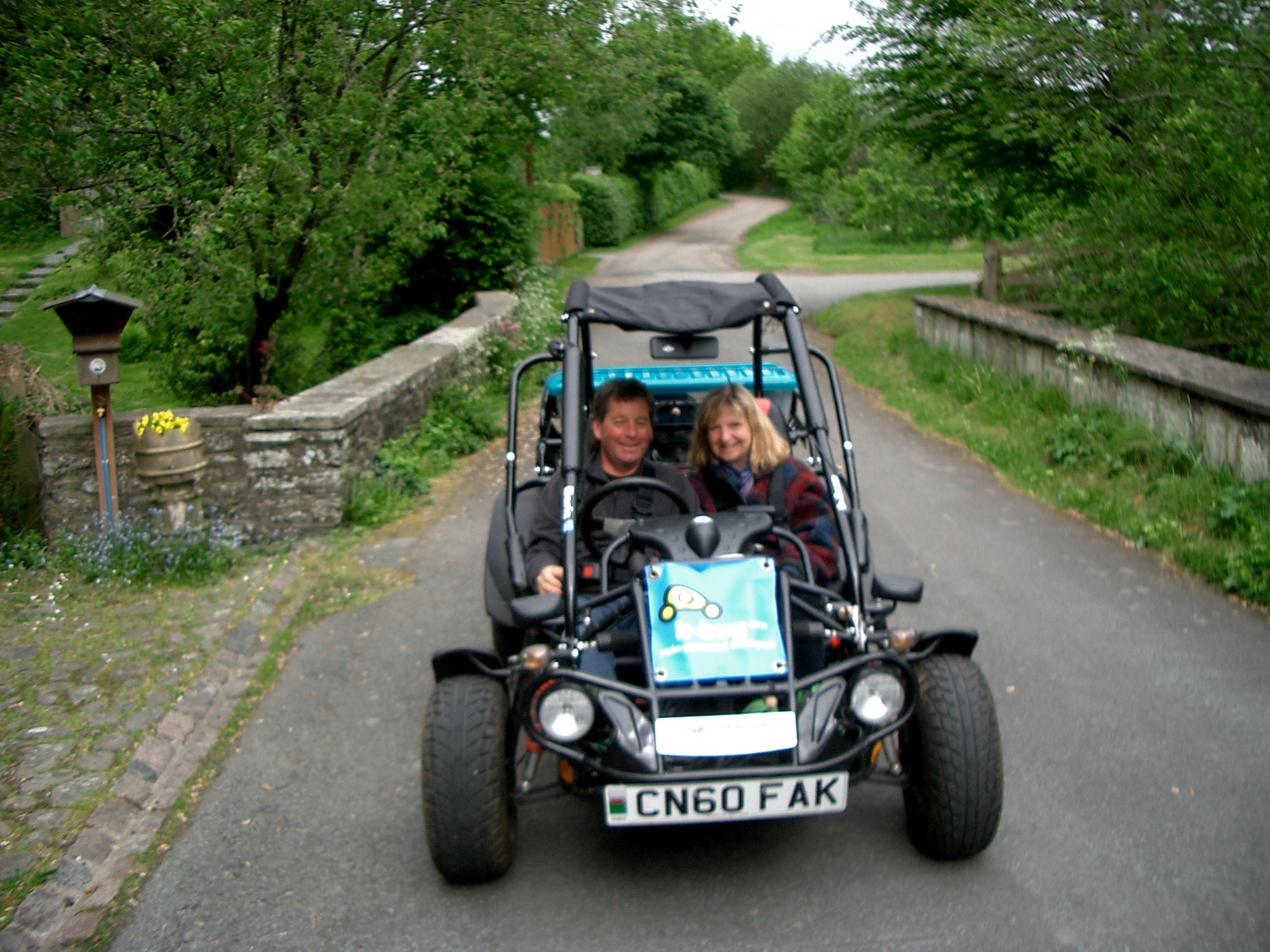
Our b-bug project with electric road legal buggies is an ongoing ‘not-car’ experiment and we are currently seeking ways to establish b-bugs as rentable vehicles for visitors to the Brecon Beacons National Park. People love driving them as an alternative to their car and at 30mph with a 25 mile range, they are fine for many of people’s local car journeys (at least in dry weather).

But, we are intrigued by whether an even lighter weight electric vehicle is possible because the lighter the vehicle, the less energy required to move it – especially if you don’t mind travelling a bit more slowly and taking a few more minutes to reach your destination.

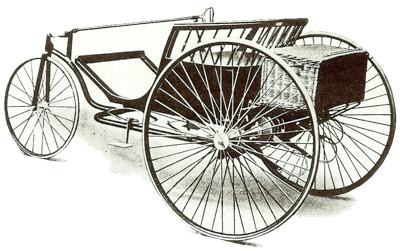
We recently discovered that my Great Grandfather, Henry Hollick designed the body for the first ever J.K. Starley electric tri-car built in the UK in 1888. Here it is:-

Intrigued, we wondered if we could experiment with something along those lines. It would also allow us to reintroduce the option of harnessing some human energy in the form of pedal power. Pedal power is so amazingly efficient, it seems a shame to waste its potential (and it keeps us healthy) but we have found that many people simply aren’t happy riding a 2 wheel bicycle. So, can we combine some of the comfortable, sitting down, side by side aspects of a car with the electric assist pedalling power of an electric bike?

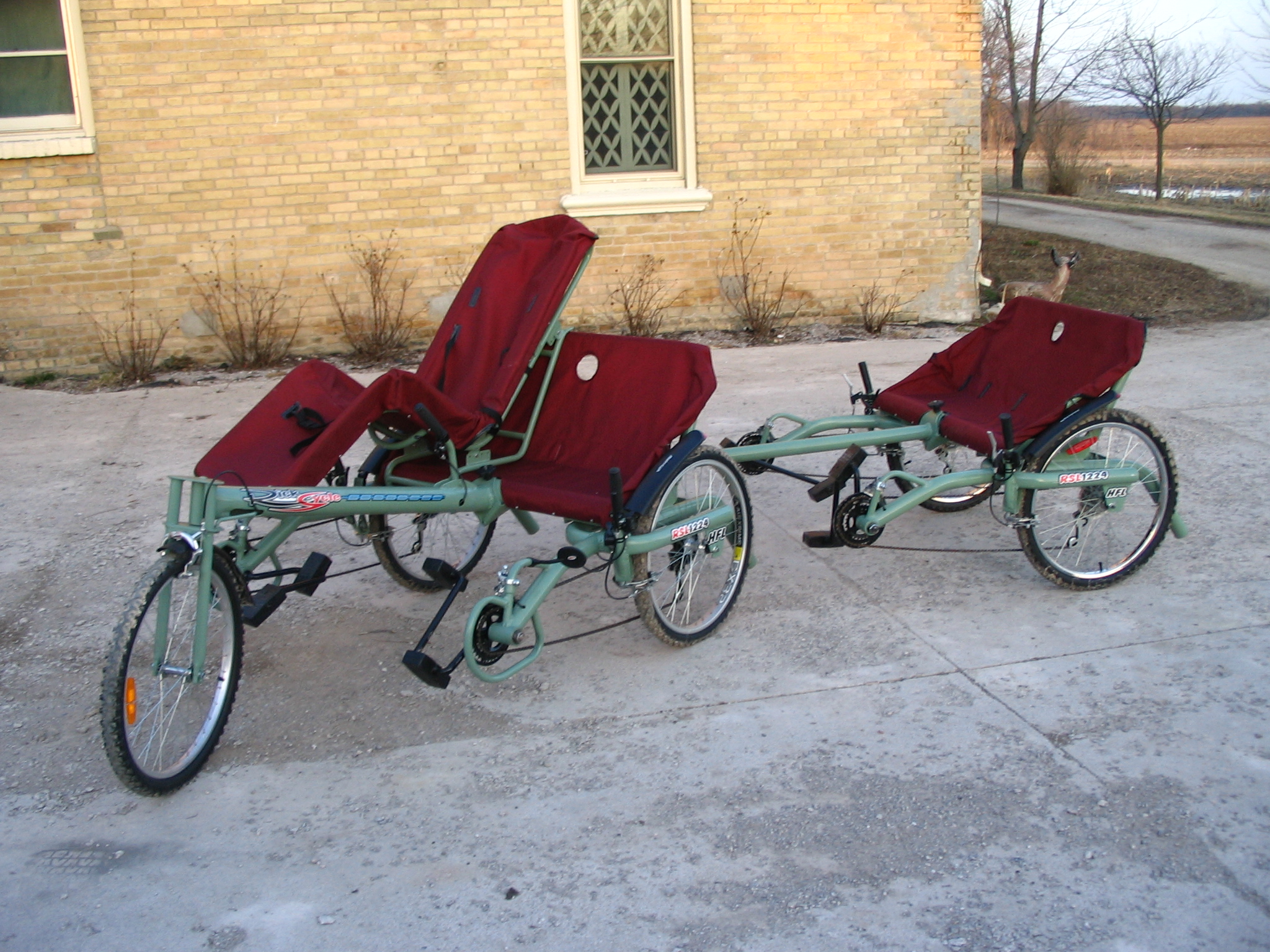
As an experimental project, The Prospectory has just taken delivery of a Ricksycle from Canada – the nearest model we can find for an electric tri-car along the lines of the one designed by Henry Hollick himself. Here we are in our first “Hollick” outing – a working run to the Post Office 2 miles away.

Freewheeling downhill to Talybont certainly gave us an enjoyable feel for what riding in the first electric tri-car in 1888 might have been like. Pedalling back up the hill reminded us that electric assistance on the ‘Hollick’ would make a big difference to its everyday utility and enjoyment and take it a step closer to its 1888 fore-runner.

Experiments will continue. Watch this space.


Posted in Psychology, Technology | Tagged , , , | Leave a comment

Light Green Transport for Rural Wales

The Prospectors are interested in introducing funky, lightweight, low energy vehicles to replace short car journeys here in rural Wales – the kind of journeys we do every day to get to work, drop the kids at school, nip to the local shops or get to the railway station. 63% of our journeys are in this category (less than 5 miles).

The b-bug is an early, opportunistic example of the kind of vehicle we have in mind as is the soon-to-be-released Renault Twizy. We are also interested in hybrid pedal and electric combinations. We want to keep them lightweight so the electricity they require can be satisfied to a large extent by our natural elements – sun, wind and water. Currently a single set of domestic PV panels can support 3-5 b-bugs and the Talybont community hydro could keep 150 such lightweight vehicles  on the road.

We want the vehicles to be practical and cheap for local residents so they can replace the 2nd car. But we also want them to be a novel and fun attraction for our many holiday visitors. Our dream is for the Brecon Beacons National Park to be the first UK destination where visitors don’t need or want a car to get around. Instead they enjoy moving around powered only by our natural elements..

You can read more about our strategy for ultra light green vehicles here.

Posted in Psychology, Technology | Tagged , , , , , , | Leave a comment

One-eyed Turks? – it’s all in the brain

OK, so I admit it, The Prospectors (when not busy Prospecting) are avid supporters of the Llanelli Scarlets  – or “one-eyed Turks” as we are known to supporters of other Welsh rugby sides. And, like most supporters, we are inclined to think that “our side” play better (and certainly more interesting) rugby than any other side.

It transpires that this well known bias amongst supporters may have a neuropsychological basis rather than simply(?) a cognitive one.

New Scientist reports this week on a study by Pascal Molenberghs at the University of Queensland in Brisbane, Australia.  He divided 24 volunteers into two teams and then asked them to judge the speed of hand actions performed by one member of each team.

Even when the hand actions were performed at exactly the same speed, the volunteers judged the actions of their own group member as faster than the other group’s member.

Brain scans showed that the brain activity (of those making the judgement) was different in the two cases – suggesting the bias arises at the perceptual stage rather than the decision-making one.

So, who knows, the moniker “one-eyed”, when referring to opposition supporters, may actually hold a grain of truth in that we may indeed perceive physical actions differently depending on which team’s actions we are watching at any moment in time.

Disappointing if the study included no control – i.e the brain scans of neutral observers who didn’t belong to either side a.k.a. “the ref”!

The Study is due to be published in Human Brain Mapping.

Posted in Psychology | Tagged , , , , | Leave a comment

Tourism, augmented reality and smart phones

Our local tourism group is exploring ways to enhance the experience for visitors to Talybont on Usk. One idea under discussion is the deployment of QR codes on the signs around the area enabling visitors (or at least those with smart phones AND a signal) the chance to augment the physical reality of the Brecon Beacons (rivers, canal, waterfalls, bike trails and hills) with in-depth information about the local history, wildlife or geography. But is this a good idea?

Unfortunately, QR codes suffer some awkward usability issues (even by people who know how to use them). But, even if they worked perfectly, perhaps the more interesting question is whether so-called “augmented reality” delivered via a mobile phone actually distracts from people’s immediate sensory, physical and mental engagement with their actual surroundings.

As a cognitive psychologist, I have always been interested in ‘transparent’ technology i.e. technology that doesn’t demand its users to attend to it but rather enables them to attend from (or through) it to the task in hand. The philosopher, Michael Polanyi talked about the power of a pen in writing in that regard or the physical articulation of words. If we focus on the feel of a pen in our hand, we no longer process the words we are writing with it. Similarly, if we focus on how our tongue and lips articulate a particular word, we can’t simultaneously parse that word’s meaning. It’s either or. Arguably, the most powerful technologies become invisible allowing us to focus our attention through them, not on them. As a recent Kindle user, I would say that Amazon are getting close to achieving that – I can almost (but not quite) focus my entire attention on the story and not notice the technology displaying the words.

Now, with augmented reality, the goal is a bit different. Here, the goal IS to add something to the physical experience and not simply enable it. But that can be a problem. Coming back to QR codes, a Graphic Designer friend recently visited the Roman remains at Caerleon where they have introduced QR codes to augment the visitor experience.

Unfortunately, what he witnessed was visitors totally absorbed in scanning QR codes or manipulating the touch screens on their smart phones. Meanwhile they weren’t even looking, touching, walking around or imagining life in the stunning remains of a Roman amphitheatre right in front of them!

Maybe, if augmented reality can manage to appear seamless with the physical reality, then the transparent technology principle can still operate. But, with a smart phone, I can see that’s tough to achieve. The biggest irony is that the old fashioned, single function, telephone (remember those?) used to be cited as the most compelling example of a technology which was totally transparent enabling us to attend 100% to the conversation it enabled. How times have changed!

Posted in Psychology, Technology | Tagged , , , , , , | Leave a comment

Exploring lightweight electric vehicles? – maybe it’s in the genes

This year, The Prospectory ran a trial of two electrically-powered open air buggies for visitors to the Brecon Beacons National Park. Boris and Blodwen – the b-bugs – enabled visitors to explore the National Park in a novel, fun and green way instead of using their cars.

80% of car journeys in rural Wales are less than 25 miles and many of these are on small country lanes. Today, people drive even 1-2 mile trips to the local shops in powerful, energy- intensive vehicles which are capable of carrying 5 people in warmth and comfort at a cruising speed of 70-80 mph for at least 400-500 miles. We were interested whether people might be happy to do some proportion of these short local journeys in a much cheaper, much slower, lighter weight, open-air, low-energy vehicle – the kind of vehicle which you wouldn’t dream of driving more than 25 miles in. In fact, something which is only a few steps up from a bicycle.

So, the b-bug concept was born and the trial results were extremely promising. People loved driving a funky outdoor vehicle (at least through the summer) and locals were quite happy to commute to work that way or run their children to school. And the b-bugs consumed only 0.14 kWh of electricity per mile (about 1/10 of an average car).

It’s certainly a different way of thinking about personal local transport – the idea , if you will, of a ‘not-car’ – electric transport which will get you from a to b but without any of the comfort, speed or range of the modern automobile.

But funnily enough that’s where the automobile started 120 years ago. In the past few days, thanks to research by my distant cousin, Christopher Lewis, I’ve been delighted to discover that my Great Grandfather, Henry Hollick, built the body for J.K. Starley’s electrically propelled tri-car in 1888 – reputedly the first motor vehicle to be made in the UK. And here’s what it looked like! A fore-runner for the b-bug?

What fun it would be to show Great Grandfather Henry (pictured right) both our Ford Mondeo and the b-bug and try to explain to him why we are now coming round full circle in our thinking about the lightweight construction and propulsive power of our vehicles! I’m sure he’d offer some insights.

Posted in Technology | Tagged , , , , | Leave a comment

Breaking habitual behaviour? – Try using the wrong hand!

We’ve been exploring how triggering a change in behaviour can disrupt  unconscious habits and lead to change. It’s never easy but it’s certainly easier than trying to change attitudes!

Much of human behaviour is unconscious, triggered by context. If you can alter the context (even in a small way), it can break the habit.

A recent study shows that when habitual popcorn eaters are in the familiar  context of the cinema, they’ll consume just as much stale popcorn as fresh popcorn even though they say they don’t like the taste of the stale stuff and they aren’t hungry. If, however, the experiment is carried out in an unfamiliar context then they don’t consume much of the stale popcorn and the amount they do consume IS affected by how hungry they are.

Perhaps more intriguingly, the experimenters got the same effect by switching which hand the popcorn munchers used. If it was their usual (i.e. dominant) hand, then they merrily consumed popcorn fresh or stale  regardless of taste or hunger levels. If asked to use their non-dominant hand, then their consumption dropped off for stale popcorn and became hunger dependent.

Hm….. I’m busy thinking of similarly simple ways to break the fluid execution of  habitual behaviours.

Posted in Psychology | Tagged , | 1 Comment

Electric Cars and “Disruptive” Technology

The term “disruptive”, when applied to technology, refers to something which replaces the incumbent technology for a particular application.  Replacing the internal combustion engine in a car with an electric motor will, it is hoped, eventually prove a disruptive technology.  At the moment, however, electric motors are not in any position to disrupt combustion engines in all cars.

In the most influential analysis of technology disruption, Clayton Christenson used many examples to show how difficult it is for a new technology to dislodge the current one. The latter has the benefit of widespead understanding, a support infrastructure, and an ongoing research and development programme that constantly refines it, year on year.  In the car industry, the efficiency of modern car engines compared with those of just a few decades ago shows this effect – despite the fact that there is hardly anything in a modern car that hasn’t been well known and understood for a generation.

Given this very common scenario, it is surprising that any disruptive technology ever makes it to market, unless it has some all encompassing technical and commercial advantage. When we study actual examples we often find, as Christenson did, that early disruptive technologies did not initially have either a technical or a cost advantage in the current dominant application.

A good example for Christenson is hydaulic mechanical digger – which the British call a “JCB” in honour of the first mass market supplier of these machines in the UK.  When these first appeared, the predominant mechanical digger used a crane arm, drag chains and a buckets to excavate prodigious quantities of material at one draw.  And you can still find machines like that at work in open-cast coal mines today, even though they have all but vanished elsewhere.  Early hydraulic diggers didn’t have the capacity to take over the most common application.  Instead, they were used for new, much smaller applications, where their flexibility and their ability to work in confined spaces enabled them to tackle jobs that a crane-type digger couldn’t.

Another more recent example of disruption is the personal computer, which has all but replaced the mainframe to the extent that large central computing facilities are now based on arrays of cut-down personal computers.  But the PC didn’t do mainframe computer work initially.  It performed useful and recreational functions for individuals, then office and clerical functions.  Cut-down lower powered mini-computers were developed to deliver mainframe applications at much lower cost to smaller companies or distributed large ones. The personal computer, now backed by the rapid evolution a huge market and many suppliers provides, was soon able to disrupt the mini-computer and then go on to replace (or perhaps one should say, redefine) the mainframe as well.

So how’s the electric car doing as a disruptive technology for personal transport?  A direct assault on the sub-compact car market – i.e. by trying to do what a car does today – will be difficult for the electric car given the weight of its batteries and how long they take to charge. For as long as batteries are a hundred times heavier than a petrol tank for the same energy storage, electric cars as currently constructed aren’t ever going to completely replace conventional ones.  However, there are some things they can already do better than a car, and if they can establish themselves sufficiently doing those things, history suggests that they will attract investment away from the incumbent technology to the point where they may eventually displace it.  Currently, however, electric cars will struggle if they attempt to persuade the mainstream car market that they represent a superior product.

Consider, therefore, a potential scenario which could explain, after the fact, how and why electric cars eventually displaced internal combustion engined cars for most consumers.

1.  The cost of fuel increases by ten-fold while the cost of electricity doubles.

2.  Electric batteries improve along the current trajectory to the point where, while they may not hold as much energy as a petrol tank in terms of weight, they can do so in terms of cost.

3.  As driving a high speed long range car becomes increasingly more costly in terms of both running cost and insurance, young people are priced out of the car-owning market.  They turn to cheap, lightweight electric cars which can fulfill the transport needs of the urban young.  These cars do not go very far or very fast, but they don’t need to.  Governments encourage them by lowering the driving age for lightweight electric cars to 16 while raising the driving age for conventional cars to 21.

4.  Inductive charging at fuel stations, lay-bys, and car parks becomes widespread to the point where pretty well everywhere is within 10 miles of a charge point.  The electricity is charged to your electricity bill, and a lightweight electric vehicle can be significantly recharged in an hour.

5.  Next generation inductive charging allows lightweight electric cars to pick up their charge from the road whie on the move.  As a result, battery sizes can reduce to cater for the longest “off-grid” trip the buyer expects to make.  These electric cars are not only more energy efficient than petrol cars, they are now significantly faster as well.

6. On the back of the lightweight wired grid infrastructure, larger electric cars and commercial vehicles with more extensive off-grid capacity start to compete with internal combustion engined vehicles in all applications.  They are already much cheaper to run, to build and to service.

6.  Combustion engined vehicles become specialist, and/or confined to off-road application in developed economies.  Their fuel is now bio-fuel derived from sustainable sources without undue impact on food supply in the Third World, because it only needs to provide a fraction of today’s vehicle power.  Developing world economies which do not (yet) have an electricity grid may instead develop a distributed power infrastructure based on renewable energy to take advantage of the cheaper electric vehicles.

This is, of course, a prediction filled with unlikely fancy, and is almost certainly not the way the World will go.  But had you predicted the the personal computer and the Internet in the mid 1960’s, you’d have sounded just as silly as this does!

Posted in Uncategorized | Tagged , , , | 2 Comments

Insurance, obstacles and the creative brain

Our trial of electric road legal buggies (b-bugs) in the Brecon Beacons National Park has come to an end, the results are all analysed and the trial report published. Given its success, we are now busy exploring ways in which b-bugs could become a reality for visitors to the Brecon Beacons. .

But, we’ve currently hit a bit of a wall.  We are struggling to find a company who will insure the b-bugs for self-drive hire. The b-bugs are type approved by the DVLA and straightforward to insure for private use. The trouble is the buggy insurance companies don’t do rental insurance. Conversely, vehicle rental insurance companies don’t cover non-standard vehicles like buggies.

The frustration of finding a solution is made worse by endless calls to insurance companies who are intent on asking their prescribed set of  questions (‘are you married?’ ‘what date do you want to start the insurance?’) in order to find you the cheapest quote. I have yet to find how to engage them in a dialogue which doesn’t revolve around such questions!

So, we are going to have to think creatively and the good news is that  recent psychology research suggests that that is exactly what the brain is good at when confronted with a constraint or barrier. Because of its rich connectivity, the brain normally puts a lot of energy into ignoring ‘spurious’ information and links – otherwise we’d never get anything decided or done.

However, studies suggest that “encountering an obstacle in one task can elicit a more global, Gestalt-like processing style that automatically carries over to unrelated tasks, leading people to broaden their perception, open up mental categories, and improve at integrating seemingly unrelated concepts.”

Insurance doesn’t feel like an obvious candidate for stimulating creative thinking but I’m writing this hoping that, in the meantime, some part of my cortex is digging out some totally spurious unconscious connections.  And, once I’m done, I shall go and lie down flat because that too is meant to help.

Posted in Psychology | Tagged , , | Leave a comment

Sustainable Agriculture

Whether or not you believe in global warming (as perhaps the majority do) or that mankind’s contribution to it is significant (as increasing numbers don’t, or would rather not) we will run out of fossil fuel.  When that happens, unless we find a substitute we can mine for a few more centuries, we’re going to have to learn to power and feed ourselves sustainably.

Very little of the food we eat in the West is sustainably produced, and there may already be more people than can be fed sustainably.  If the oil ran out tomorrow, most of us in the West (at least) would starve (which might cause the planet to breathe a sigh of relief but otherwise not be considered by many to be a Good Thing). And farmers would starve along with the rest of us, because they need a lot of fossil fuel to produce our food.

So can farming be made sustainable in the sense that it could manage without direct or indirect fossil fuel input?  The farms of old were, like the rest of the economy, sustainable.  They were, like the rest of the economy, far more labour intensive than today, although they probably used less energy per calorie of food produced than developed countries do today.  The large number of farm workers and draught animals would still have needed feeding, of course, but all the energy they consumed would still have originated on the farm and would still have produced a surplus.

Ultimately, all energy comes from sunlight.  Fossil fuel is simply 300 million years of sunlight locked away in the earth to be liberated by mankind in a little over 300 years. Before that, we burned wood, liberating sunlight captured over a couple of decades, and grazed horses liberating sunlight captured in the last year.  If you can  grow firewood and grass as fast as you use them, you can keep it up indefinitely – i.e. it’s sustainable.

Organic farming does not consume fossil fuel to provide fertilisers and pesticides but those organic farmers who still power their machines and generate heat from fossil fuel are no more sustainable in the long run than any other type of farming.  In that respect, sustainability is a binary proposition.

But farm machinery can be powered by oil extracted from currently growing plants and other organisms, so farming can avoid using fossil fuel – and indeed in much of the non-Western world it probably still does. Today, that requires setting aside some proportion of crop land to provide the fuel necessary to cultivate, harvest and process the remainder.  This is what the farmers of old did, and what the extremely efficient Amish farmers of today do.  The Amish, of course, use horses to power their machines, and horses also provide some of the fertiliser for the land they cultivate. But while we may not be able to afford to go back to horse-powered agriculture, we might be able to go back to plant-powered.  Using farmland to grow fuel for combustion engines threatens food supply, and there isn’t enough land in the UK to fuel all the cars, trucks, trains and aircraft the UK uses.  But just providing the fuel for farm machinery – which is what our ancestors did – is still feasible, and might enable our farmers to maintain the efficiency while dramatically improving the sustainability of what they do.

There are academic studies of this on-line, but simply put you can extract a little over 1000 litres of rape seed oil per hectare in the UK, and you need a little over 100 litres of that to drive the tractors and machinery to cultivate that hectare.   That’s the good news. The bad news is that a farmer can get 70p a litre for rape seed oil while his red fossil diesel costs him 60p.  Until that changes, it’s hard to see what else will.

As we run out of fossil fuel, of course, its price will increase, but since a growing proportion of the diesel and petrol we all buy is now (by law) biofuel – i.e. extracted from plant sources – so will the price of rape seed oil.  So long as the subsidised price of fossil fuel for agriculture remains below the market price for bio-fuel feedstock, modern farming will be as unsustainable as the rest of our economy.

Posted in Technology | Tagged , , , | Leave a comment