Idea Fund Award : Detox Bio Embellishment: Non-mined gemstones

Our first ‘I’ve got an Idea’ Fund award of 2025 is to Cassie Quinn for her lab experiments into creating reflective sparkles using biopolymers. Intriguingly, the idea was born from a mistake made in an experiment of Cassie’s while producing wastewater-cleaning sequins. Her project will now investigate this phenomenon (see image) and how to reproduce it. Her goal is to retain biodegradability in sequin and embellishments and creating gemstones like amber and opal using non-extractive methods.

Why does this matter? For a start, it’s reported that British women purchase 33 million sequinned garments every festive season, with 1.7 million ending up in landfill after only 5 years and 35% of microplastics being released into the world’s oceans. These conventional sequins are made of polyester film or vinyl, which involve toxic and carcinogenic chemicals that cause significant environmental and health risks.

You could argue, why don’t we ‘simply’ ban sequins if they generate such toxic waste. But our use of and attraction to glittering objects like sequins is certainly no trivial modern whim. Their construction and decorative use reach back in time for at least 12,000 years and across many diverse civilisations. It is only in recent times that we have switched from first shells and later metal coins to toxic micro plastics for sequin construction. And why is sparkle important to us? Certainly, our fellow, non-human creatures have evolved bright, eye catching colours and display to attract others – while we have done the same through articles we wear or carry or by directly painting our faces and bodies. Some research in evolutionary aesthetics also suggests that humans prefer shiny objects because glossiness connotes water which has always been vital for life.

So, we wish Cassie luck in exploring ways to give us sparkling sequins without microplastics, dyes and their toxic waste effects.

Posted in Uncategorized | Tagged , , , | Leave a comment

Latest Idea Fund Award

We are are pleased to announce the ‘BLCK BOX’ project as the latest winner of an ‘I’ve got an idea’ Fund award .

BLCK BOX is the idea for an innovative tool that uses granular data from sensors to create digital twins for commercial buildings. The digital twin is capable of accurately quantifying heat loss on a room-by-room basis that is viable for a reliable decarbonisation strategy for commercial buildings. The model can be used to highlight fabric improvement opportunities as well as provide accurate measurements for heat pump sizing

Raw data of mix of return and flow temperatures (pipe temperatures) and ambient temperatures

The Prospectory Idea Fund is covering the purchase of the necessary sensors for the project’s initial experimentation in 2 test buildings to validate the concept.  The plan is to use the first part of the 2024/25 heating season for data collection and digital twin building and the 2nd half of the heating season to validate the outcome of the new models. One data point per sensor will be collected every minute for a period of 6 weeks generating approximately 1 million data points to build a sophisticated digital twin. The project team will then validate their calculations with smart gas meters and also heat meters already installed in the buildings.

The Idea Fund always welcomes applicants who are testing their ideas through their own DIY experimentation however sophisticated or simple in kind.

Posted in Uncategorized | Tagged , , , | Leave a comment

Keeping the elderly warm this winter……

Over the past 3 years, I have been researching the problem of how to keep people warm in our wide diversity of UK housing without wasting energy and keeping costs manageable. My studies have included conventional central heating, heat pumps and Infrared heating and, most recently, I sampled how warm 77 individuals in 61 different homes felt at particular moments in time over 30 winter days. The current air temperature in the room they were in was also recorded along with their recent activities.

The most striking findings from the studies are:

  • there is wide variability in how warm individuals feel on a 7 point scale… even compared to other members of their household
  • the current air temperature is not a significant factor (only accounting for 14% of this variance)
  • people’s felt warmth varies at different times due to a complex and unpredictable combination of ‘in the moment’ physiological, physical, psychological, behavioural and contextual factors
  • the different forms of heat: convection, conduction or radiation matters. Interestingly, 87% of the 71 houses studied had some form of hybrid heating that they used in addition to their main form of heating, e.g. log burners, agas, fan heaters or portable radiators.

Co-incidentally, our community hydro company, Talybont on Usk Energy, has funded an offer of 25 electrically heated throws to elderly members of our small rural community this winter if they are suffering from feeling cold. I have spent the past week delivering throws to folk who have requested them. Anecdotally, in line with my research studies, it’s proving a further example of the fact that warm air doesn’t actually heat us (until it reaches 37 degs!) but is important in reducing how quickly we lose bodily heat. In every home I’ve visited, the air has felt comfortably warm (20 degs plus) thanks to the central heating or heat pump being on but residents still feel uncomfortably chilly in their legs or back or shoulders and are often operating a portable electric bar or fan heater to supplement their central heating.

If people are sitting still for large stretches of time and are also elderly and frail, they can become cold and then need either vigorous exercise or a conductive or radiant heat source to warm their bodies directly. The good news is that electrically heated throws deliver a conductive effect quickly and effectively and do so by consuming only 160w – about 6 times less energy than an electric heater which is attempting to raise the air temperature. The heat level is also under each person’s direct control and studies have shown that people simply feel warmer if they know they are in control of the heat source – hence the temptation to turn up the thermostat even if that isn’t actually necessary or effective in raising their body heat.

Food for thought…

..

Posted in Uncategorized | Tagged , , , , | Leave a comment

‘I’ve got an idea’ Fund – braille project news

Great to hear update news from one of our 2023 fund winners on their experimental development of a digital Braille Reader to include graphics to enable blind people to play digital games.

Ed has sent us 2 short videos of recent developments . The first video shows a user playing the game experiencing the value of a multi-line display reader so users can effectively scan the display to pick up action and respond. The 2nd video shows a blind 16 year old programming his own new game using the multi-line braille display.


https://www.youtube.com/watch?v=aGZq53cSTnc

https://www.youtube.com/watch?v=wPc2d2hpmS0

The former is making existing games accessible, the latter is a blind
kid (16yo) developing his own.

Posted in Uncategorized | Tagged , , | Leave a comment

SEA Talk on my Thermal Comfort Study

Slide set from my presentation to the Sustainable Energy Association is now available here.

Interesting questions and discussion ensued.

Posted in Uncategorized | Leave a comment

‘Creating gods for our time’ – Invite to a workshop

‘Creating gods for our time’ – 3 day residential workshop https://larksandravens.com/an-invite/
14th-17th October 2024.
Centre for Alternative Technology, Machynlleth, Wales, SY20 9AZ

A Visual artist & Experimental psychologist duo (a.k.a. Larks & Ravens) are looking to bring together 6 diverse creative practitioners and thinkers to playfully address the question “what gods have shaped our current world and what counter gods could we imagine and create who might challenge and help us reshape the narrative?”. Over the 3 days, we will think, eat, imagine, share ideas and practices and co-create a panoply of lifesize gods with different transforming narratives.

Applications from artists and philosophers, to story tellers and puppet makers welcome – closing date for applications is 02/09/2024 https://larksandravens.com/an-invite/

Posted in Uncategorized | Leave a comment

Idea Fund Award – Thermal insulation from crop waste

We are delighted to announce our latest ‘Ive got an idea’ Fund award to Antoinette Oni – an architectural designer, materials researcher and artist.

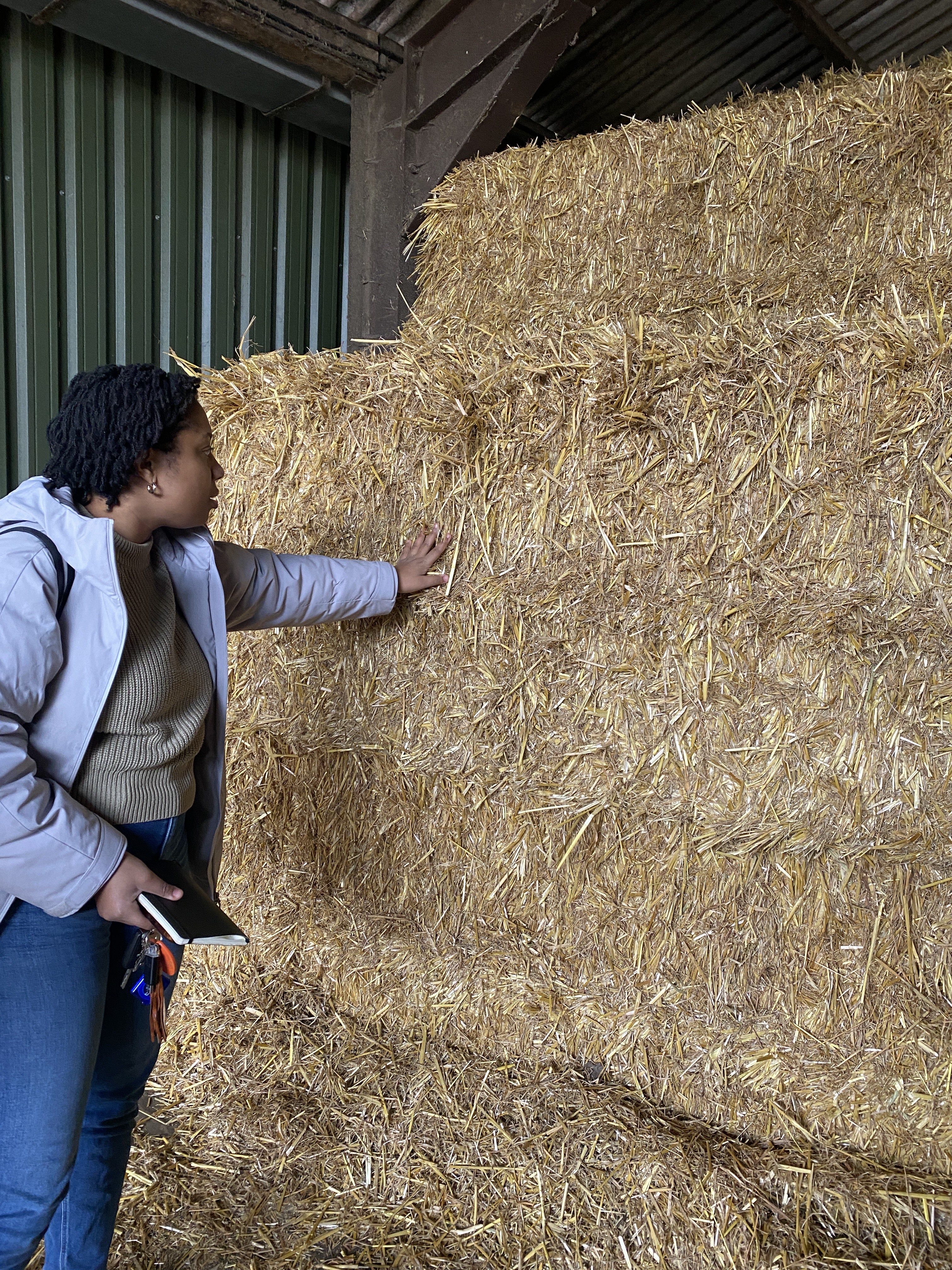
Antoinette is working on how to create thermal insulation boards from a composite based on abundant crop waste material here in the UK. She explains: “Finding uses for agricultural waste byproducts has become increasingly popular for material researchers in recent years as it’s such abundant biomass. However, a lot of the research is coming from tropical regions using crop waste relevant to those climates. What I’m proposing is utilising the most abundant crop waste in the UK, straw, to make a board that is completely circular and non-toxic with no additional binders. The process I’m developing draws on the amazing natural capabilities of the straw fibres. I’ve carried out extensive research and I’m yet to see my unique process published in any academic paper so far. Also, the application of this board as thermal insulation in the British climate is underexplored.” 

Our funding will enable Antionette to purchase the materials and equipment she needs to experiment with processing the material, build her first prototype and install it in conditions to test its durability and performance. We will follow her project with interest.

Posted in Uncategorized | Tagged , , , | 1 Comment

Thermal Comfort Study Report – Now available

I have just completed a study exploring the main factors which affect individuals’ thermal comfort in their everyday lives at home. This is in contrast to the majority of thermal comfort studies which are carried out in controlled lab conditions. The study collected thermal warmth samples on 30 winter days from 77 participants in 61 UK homes heated either by Heat pumps, Infrared panels or conventional central heating.

People’s level of thermal comfort was very variable – both for individuals at different times and between individuals (even those living in the same house). Air temperatures in the room accounted for only 14% of this variance which is consistent with some earlier studies. People are variable and unpredictable in both their behaviour and psychology and unique in their anatomy, physiology and sensory experiences. This creates a challenge for attempts to deploy sophisticated technology to control home temperatures as a way to deliver ‘universal’ thermal comfort.

You can read the full report here.

Posted in Uncategorized | Tagged , , , | Leave a comment

Thermal Comfort Study underway

As the core part of my thermal comfort study, I am currently polling 86 participants from 65 different UK households every day for 30 days at different times of day with a quick survey of how warm they feel at that moment, the room temperature, and a list of factors which might be affecting their felt warmth, e.g physical or mental activity, what room heating is on and how many layers of clothing they are wearing. The households include Heat pumps, Infrared heating and conventional gas or oil boilers.

The daily data are pouring in and look fascinating. I’m really enjoying the anecdotal comments people sometimes add. This part of the study finishes at the end Of February and then the monster data analysis begins…..

Posted in Uncategorized | Leave a comment

Progress on our ‘Ive got an Idea’ fund projects

It’s always inspiring to hear from our various ‘I’ve got an Idea Fund’ projects on challenges they have faced and progress they are making in developing and testing their very different technical ideas. Turning ideas into reality is never straightforward! This past week, I’ve heard of encouraging steps forward from the melodica sound project in Ireland, the collagen fish waste extraction for contact lenses in London and lastly the geometric inspired collapsible accommodation on the Isle of Arran in Scotland. Alistair on Arran has now got a set of 1/10th scale architectural style models showing the frameworks relative to lifesize – the collapsed structure being towed by a bike and then the stages of unfolding to the final size.

Posted in Uncategorized | Leave a comment